
A money market account pays interest like a savings account but usually adds check-writing and debit card access. A savings account is simpler and rarely offers those transaction tools. Both are FDIC-insured up to $250,000 per depositor, per bank.
What is a Savings Account
A savings account is a deposit account built for one job: holding money while it earns interest. You deposit cash, the bank pays you a set annual percentage yield (APY), and you withdraw through an ATM, a teller, or an online transfer to checking.
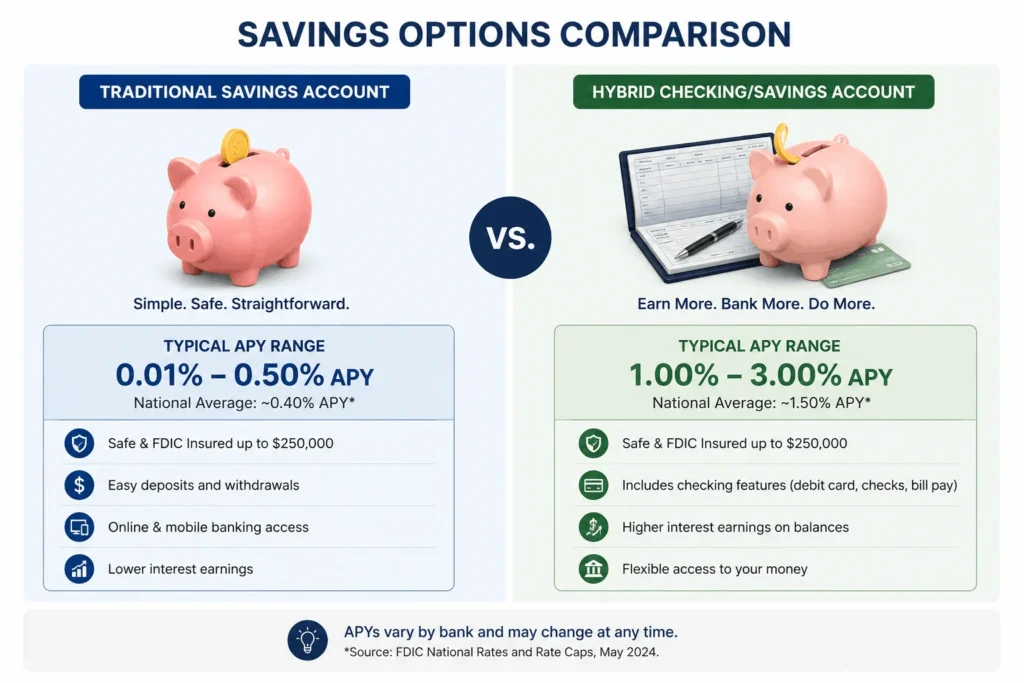
Most savings accounts don’t come with checks or a debit card. That’s by design. Big brick-and-mortar banks like Chase and Bank of America often pay around 0.01% APY on standard savings accounts, according to Bankrate’s rate tracking. Online banks such as Ally and Marcus by Goldman Sachs routinely pay far more, sometimes in the 4.00% to 4.20% range, because they carry lower overhead. If the transaction perks of a money market account aren’t the deciding factor, it’s worth revisiting the core benefits of a savings account on their own before choosing.
What is a Money Market Account
A money market account, or MMA, is a hybrid. It earns interest the way a savings account does, but it also gives you some of the spending tools you’d expect from checking, including checks and a debit card at many banks. Citizens Bank, for example, allows check writing and debit card access on its money market accounts, though it caps certain transaction types at six per statement period.
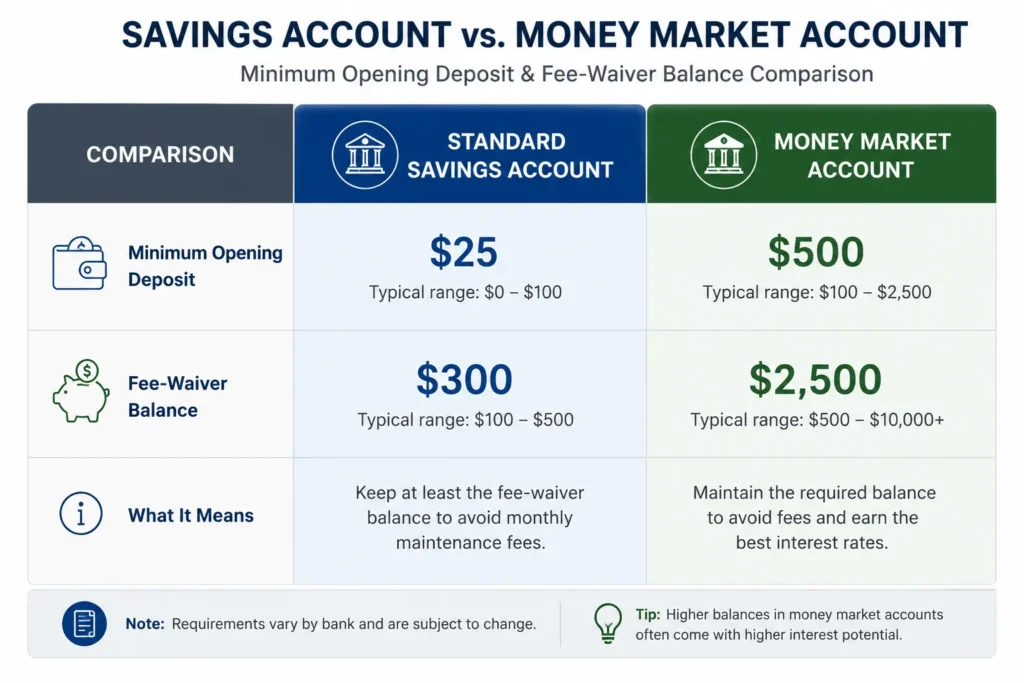
Money market accounts usually ask for a higher opening deposit than savings accounts. Citizens lists a common threshold of around $2,500 to avoid a monthly fee, and other banks set tiers anywhere from $1,000 to $25,000 for the top rate. The tradeoff is straightforward: put more money in, unlock a better yield and more flexible access.
Don’t confuse a money market account with a money market fund. A money market fund is an investment product sold through a brokerage, and it isn’t FDIC-insured. A money market account is a bank deposit account, insured the same way a savings account is. A money market account isn’t the only alternative worth weighing — how a CD compares matters too if locking the money away for a fixed term is an option.
Money Market Account vs Savings Account: the Core Differences
1. Interest Rates and APY
Rates on both account types move with the broader interest rate environment, so neither one locks in a fixed return. As of mid-2026, top-yielding money market accounts and high-yield savings accounts land in a similar range, often 4% APY or higher at competitive online banks, while the national average for standard accounts sits well under 1%.
The gap that used to favor money market accounts has mostly closed. Bankrate’s chief financial analyst Greg McBride has noted that if the only goal is the highest yield, the choice between the two account types comes down to six of one, half a dozen of the other. Check-writing need is usually what tips the decision.
2. Minimum Balance Requirements
This is where the accounts diverge more clearly. Many savings accounts, especially at online banks, have no minimum balance at all. Money market accounts more often require a minimum deposit or an ongoing balance to open the account, waive a fee, or earn the advertised rate.
3. Access to your Money
A savings account typically limits you to online transfers, ATM withdrawals, or in-branch requests. If you need to pay a bill directly from savings, you transfer the funds to checking first, which can take one to three business days.
A money market account skips that extra step for many purchases. You can write a check straight from the account or swipe a linked debit card. That makes it useful for a planned expense, like a down payment or a contractor’s invoice, where you want the funds to stay in an interest-earning account until the moment you spend them.
4. Withdrawal Limits and Fees
The Federal Reserve dropped its Regulation D rule requiring a six-withdrawal monthly cap back in 2020, but plenty of banks still enforce their own version of that limit on both account types. Citizens Bank, for instance, caps certain transfers and checks at six per statement period and will convert a money market account to non-interest checking if a customer exceeds that limit three times within a rolling 12-statement period.
Fees also differ by account and bank rather than by account type alone. A money market account is more likely to carry a monthly maintenance fee tied to a minimum balance, while many online savings accounts charge no monthly fee at all.
5. FDIC and NCUA Insurance
Both accounts carry the same protection. Deposits at an FDIC-insured bank are covered up to $250,000 per depositor, per institution, per ownership category. Credit unions offer the equivalent protection through the National Credit Union Administration (NCUA). Your principal is safe in either account type as long as the institution is federally insured.
Which one Earns more Money on $10,000
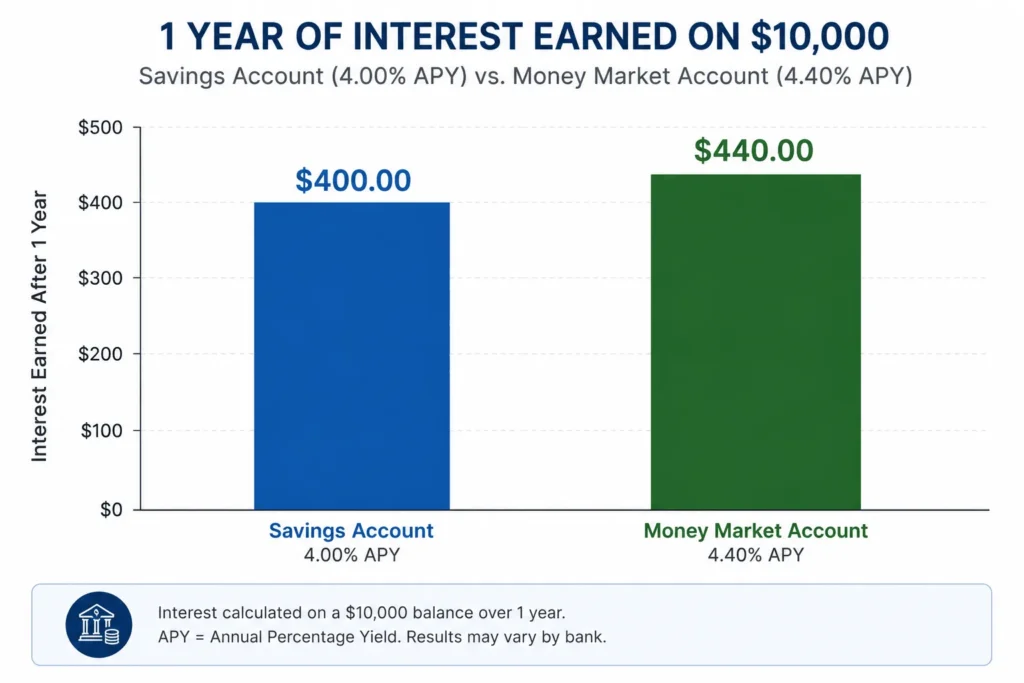
Run the math on a lump sum and the answer depends entirely on the specific rate each account pays that year, not the account type itself. Bankrate has compared the two using a $10,000 deposit and found the best savings and money market rates from competitive banks land within a few basis points of each other, sometimes with the money market edging ahead and sometimes the reverse.
When a Savings Account Makes More Sense
Choose a savings account if you want the simplest possible setup and the highest APY without worrying about a balance threshold. It also works well as a psychological barrier: without a debit card sitting in your wallet, you’re less likely to dip into money you meant to leave alone. That makes it a solid home for an emergency fund or short-term goal like a vacation or holiday budget.
When a Money Market Account Makes More Sense
Choose a money market account if you expect to write a check or use a debit card straight from your savings from time to time. Freelancers and independent contractors sometimes use one to set aside quarterly tax payments, since the funds earn interest but stay one debit card swipe away when the payment is due. It also suits medium-term goals, like saving toward a wedding deposit, where you want steady, occasional access without transferring money first.
Can you have Both Accounts
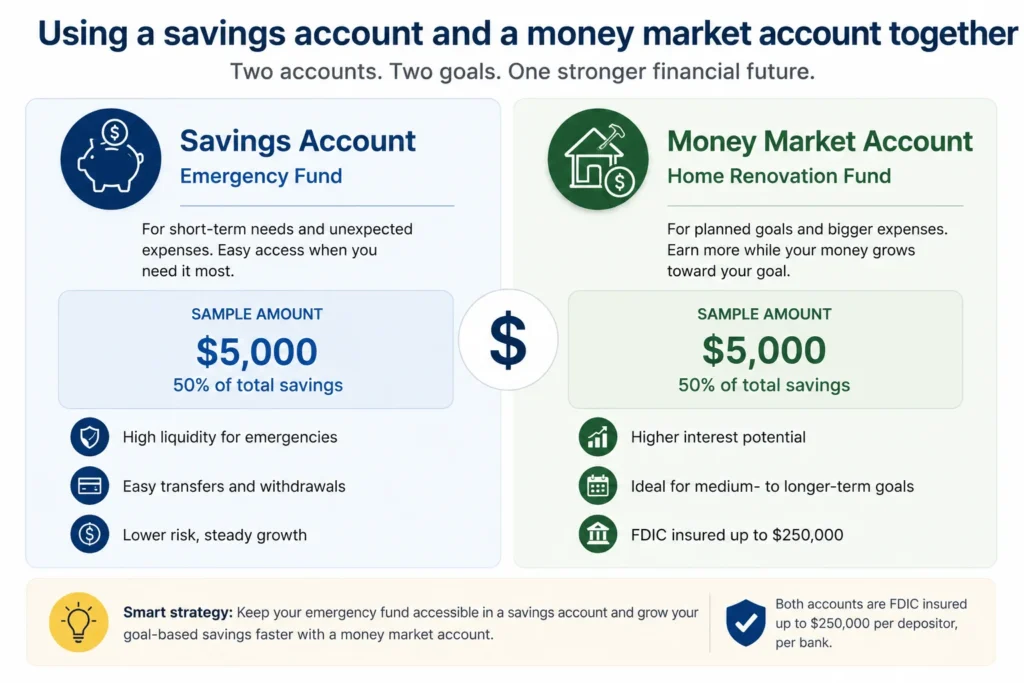
Yes, and many savers do. A common setup pairs a no-fee, high-yield savings account for a pure emergency fund with a money market account for a goal that needs occasional check-writing or debit access, such as a home renovation fund. Splitting money this way keeps each account matched to a specific purpose instead of forcing one account to do every job.
FAQ’S
1. Is a money market account better than a savings account?
Neither is better in every case. A money market account usually adds check-writing and debit card access, while a savings account is simpler and often has no minimum balance. Compare the actual APY and fees at your bank before deciding.
2. Can I lose money in a money market account?
No, not in a money market deposit account at an FDIC-insured bank or NCUA-insured credit union. Your principal is protected up to $250,000 per depositor, per institution. This is different from a money market fund, which is an uninsured investment product.
3. How many withdrawals can I make from a money market account per month?
Federal rules no longer cap withdrawals at six per month, but many banks still enforce their own limit, often six per statement period for certain transaction types. Check your bank’s specific policy, since exceeding the limit can trigger fees or an account conversion.
4. Do money market accounts require a minimum balance?
Many do. Requirements range from a few hundred dollars to $25,000 or more at some banks, depending on the rate tier you want to reach. Some online banks offer money market accounts with no minimum balance requirement.
5. Which account is better for an emergency fund?
A savings account is often the simpler choice for an emergency fund because it typically has no minimum balance and no debit card tempting you to spend it. A money market account can work too if you want interest plus occasional check-writing access for larger emergency expenses.