


A savings account keeps your money safe while it earns interest, stays easy to access, and stays separate from everyday spending. It helps you build an emergency fund, reach short-term goals faster, and develop steady saving habits without locking your cash away for years.
What A Savings Account Actually Does
A savings account is a bank or credit union account built to hold money you are not spending right away. Unlike a checking account, it is not meant for daily transactions like paying bills or swiping a debit card. Most banks limit how often you can withdraw from a savings account each month, which is part of what keeps the money there instead of getting spent.
The bank uses part of the money you deposit to fund loans for other customers. In return, it pays you interest on your balance. The rate varies a lot between banks, so a $1,000 balance in one account might earn $5 a year while the same amount in a high-yield account could earn $40 or more.
Main Benefits Of A Savings Account
Safety For Your Money
Money sitting in a savings account is safer than cash kept at home or funds parked in a risky investment. In many countries, deposits up to a certain limit are covered by a government-backed insurance scheme, so if the bank fails, you do not lose your balance. The exact coverage limit depends on where you bank, so it is worth checking your local deposit insurance rules directly with your bank or regulator.
Easy Access To Cash
You can usually withdraw from a savings account within a day, sometimes instantly through an ATM or mobile transfer. That is a real advantage over investments like stocks or fixed deposits, which can take longer to cash out or come with a penalty for early withdrawal. If your car breaks down or a medical bill shows up, the money is there when you need it.
Interest That Grows Over Time
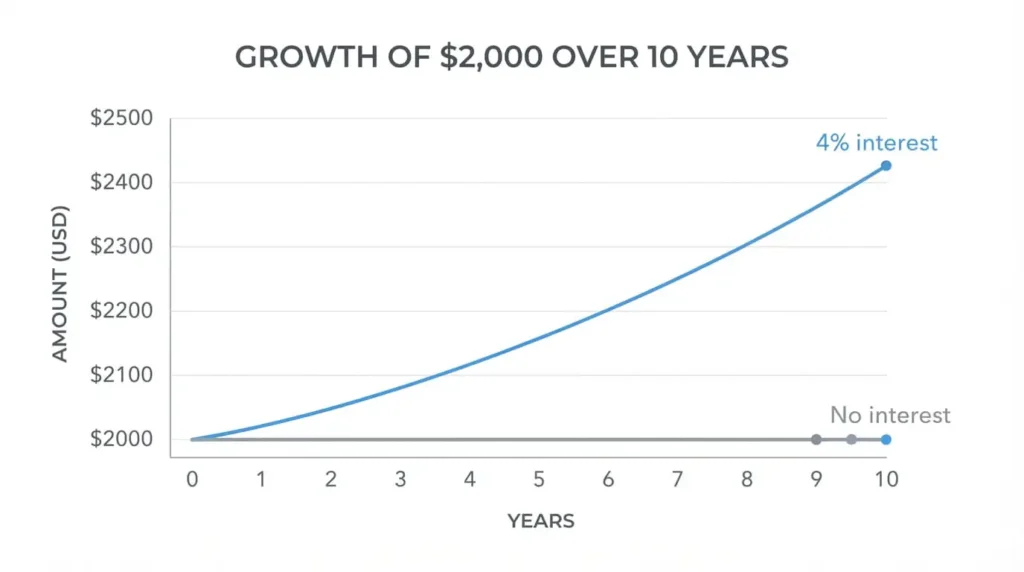
Even a modest interest rate adds up because of compounding. If you deposit $2,000 in an account paying 4% annually and leave it untouched, you would have about $2,080 after one year and roughly $2,433 after ten years, assuming the rate stays the same.
Builds A Habit Of Saving
Setting up automatic transfers from checking to savings takes the decision-making out of saving money. Someone who moves $50 every payday into savings will have $1,300 set aside after a year without having to think about it each time. That habit tends to stick once it is automated, because there is no monthly choice to make.
Useful For Emergency Funds
Financial advisors commonly suggest keeping three to six months of living expenses in an account you can reach quickly, and a savings account fits that job well. It is liquid enough to use in a crisis but separate enough from your checking account that you are less likely to dip into it for a night out or a new pair of shoes.
Helps You Reach Short-Term Goals
A savings account works well for goals with a clear deadline: a wedding next year, a security deposit for a new apartment, a holiday trip in six months. Because the balance does not lose value from market swings the way stocks can, you know the amount will be there when you need it, plus whatever interest it earned along the way.
Separates Spending From Saving
Keeping savings in a different account than your everyday spending money makes it harder to accidentally spend what you meant to save. Many banks let you open several savings accounts and label each one, such as “car repair” or “vacation,” so the money has a purpose attached to it instead of blending into your general balance.
Savings Account Vs Other Options
A checking account is built for frequent transactions and usually pays little or no interest. A fixed deposit or CD often pays a higher rate than a regular savings account but locks your money away for a set term, with a penalty if you withdraw early. Stocks and mutual funds can grow faster over the long run, but the balance can also drop, which makes them a poor fit for money you might need next month.
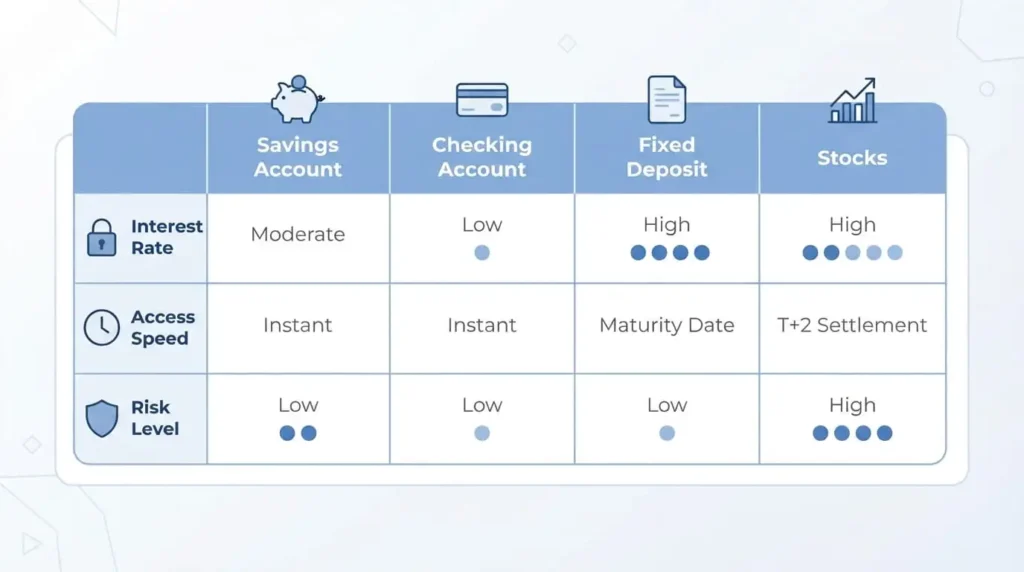
A savings account sits in the middle of these options: lower growth than investing, but far more flexible and predictable than locking your money away.
Who Should Use A Savings Account
Almost anyone with money they do not need immediately can benefit from one. Someone starting their first job can use it to build an emergency fund from scratch. A freelancer with uneven income can use it to smooth out slow months. A parent saving for a child’s school fees can use a labeled account to track progress toward that specific goal. The account works less well as a place to grow long-term wealth, since inflation can outpace the interest rate over many years.
How To Get The Most Out Of A Savings Account
Compare Interest Rates
Rates differ widely between banks, and online banks often pay more than traditional branch banks because they carry lower overhead costs. Checking your bank’s current rate against two or three competitors once a year takes a few minutes and can mean a noticeably higher return on the same balance.
Watch For Fees
Monthly maintenance fees, minimum balance requirements, and excess withdrawal charges can quietly cancel out the interest you earn. Reading the account’s fee schedule before opening it, and again if the bank changes its terms, protects the return you are actually getting.
Automate Your Deposits
Set up a recurring transfer for the day after payday, even if it is a small amount. Increasing the transfer slightly whenever you get a raise keeps the habit growing along with your income, without ever feeling like a big adjustment.
Conclusion
A savings account earns interest, stays accessible, and keeps money separate from everyday spending, which makes it a practical first step for building an emergency fund or saving toward a near-term goal. It will not outpace inflation over decades the way investing can, but for money you need to keep safe and reachable, it does the job well.
FAQ’S
1:What Is The Main Benefit Of A Savings Account?
The main benefit is that your money stays safe and earns interest while remaining easy to withdraw when you need it, unlike investments that can lose value or take time to cash out.
2:Is A Savings Account Better Than Keeping Cash At Home?
Yes, in most cases. Cash at home earns nothing and can be lost, stolen, or damaged, while a savings account earns interest and is typically protected by deposit insurance up to a set limit.
3:How Much Interest Can I Actually Earn?
It depends on the bank and the current rate. A traditional bank might pay under 1% a year, while an online high-yield savings account can pay several times that, so comparing rates before opening an account matters.
4:Can I Lose Money In A Savings Account?
Your balance will not drop from market swings the way it can in stocks, but fees or inflation can reduce the real value of your money over time if the interest rate does not keep up.
5:How Is A Savings Account Different From A Checking Account?
A checking account is built for frequent spending, like debit card purchases and bill payments, while a savings account is built to hold money you are not using right away and usually limits withdrawals.
6:Do I Need A Large Deposit To Open A Savings Account?
Not usually. Many banks let you open a savings account with a small initial deposit, sometimes as little as $1, though some accounts require a minimum balance to avoid a monthly fee.