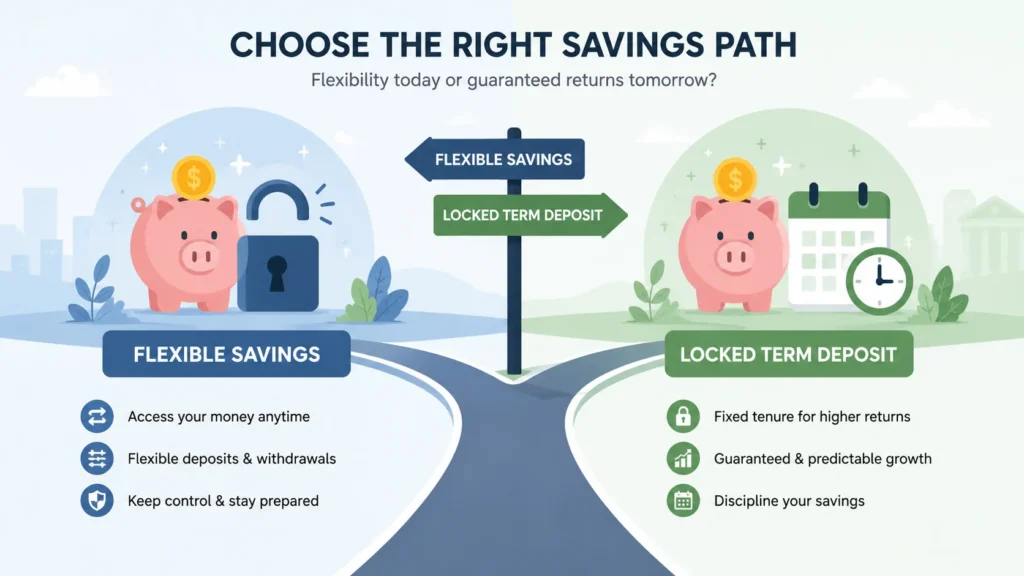

Parking cash in a plain checking account means leaving money on the table. Both money market accounts and certificates of deposit pay meaningfully more, but they work in very different ways. A money market account keeps your funds within reach and pays a rate that shifts with the market. A CD asks you to lock your money away for a set stretch of time in exchange for a rate that won’t budge.
This guide walks through how each account functions, where they’re similar, where they split apart, and how to match the right one to your actual savings timeline.
Money Market vs CD: The Quick Comparison
Think of a money market account as a savings account with extra privileges — check writing, a debit card, and a rate that moves with the broader market. A CD is closer to a loan you make to the bank: you hand over a lump sum for a fixed period and get a locked-in rate in return.
The core trade-off hasn’t changed for decades. Money market accounts give you freedom and a rate that can rise or fall. CDs give you certainty, but only if you’re willing to leave the money untouched.
What Is a Money Market Account
A money market account (MMA) is a deposit account offered through banks and credit unions that generally outpaces a basic savings account on yield. Coverage comes from the FDIC at banks and the NCUA at credit unions, both up to standard limits, so your principal stays protected even if the institution runs into trouble.
1. How a Money Market Account Works
Your balance earns a variable rate that adjusts as the bank responds to shifts in broader market conditions, particularly movements tied to the federal funds rate. Many MMAs come with a debit card, check-writing privileges, or both, though the number of transactions allowed each month may still be capped depending on the institution.
Interest typically compounds daily and credits monthly, so growth compounds a bit faster than in accounts with less frequent compounding. Some banks also offer tiered rates, where a bigger balance unlocks a better yield.
2. Advantages and Drawbacks of a Money Market Account
Liquidity is the standout benefit. You can pull funds out, write a check, or swipe a linked card without hitting a penalty or waiting on a maturity date. That makes an MMA a strong fit for an emergency fund or a near-term goal like a car purchase.
The downside is that the rate can move against you. If the broader rate environment softens, your yield drops without warning. Many MMAs also carry minimum balance thresholds — fall below them, and you might face a monthly fee or lose access to the top advertised rate.
What Is a Certificate of Deposit (CD)
A CD is a time deposit. You commit a lump sum to a bank or credit union for a fixed term — usually somewhere between three months and five years — and lock in a guaranteed rate for that whole stretch. Like MMAs, CDs carry FDIC or NCUA protection up to standard coverage limits.
1. How a CD Works
You pick a term and deposit a set amount, often with a required minimum to open. The rate locks in the day you open the CD and stays fixed no matter what happens to market rates afterward. Once the term ends, you can withdraw the balance and interest, roll it into a new CD, or let the bank auto-renew it, depending on the account’s terms.
Pulling money out early almost always triggers a penalty — commonly a set number of months’ interest. That penalty structure is exactly why a CD is a poor choice for money you might need on short notice.
2. Advantages and Drawbacks of a CD
Rate certainty is the biggest draw. Once locked in, you know precisely what the CD will earn for its full term, regardless of where rates move afterward. CDs also tend to beat money market rates on longer terms, since you’re giving the bank a firmer commitment.

The trade-off is reduced flexibility. Your funds are essentially off-limits without a penalty until maturity. And if rates climb after you lock in, you’re stuck at the lower rate unless you break the CD early and eat the cost.
Money Market vs CD: The Core Differences
1. How Rates Are Set
Money market rates float and can change at any time without notice. CD rates lock in the moment you open the account and stay put for the full term, trading flexibility for predictability.
2. How Easily You Can Reach Your Money
Money market accounts offer ongoing access through checks, transfers, or a card, within whatever transaction limits the bank sets. CDs lock funds away until maturity, and breaking that lock early usually costs you a penalty that can eat into — or wipe out — the interest you’ve earned.
3. Deposit and Balance Requirements
Money market accounts often carry an ongoing minimum balance to dodge fees or unlock the best rate. CDs usually just require a single opening deposit, since you can’t add or withdraw funds mid-term anyway.
4. Best Use Case for Each
A money market account suits an emergency fund, a house down payment you might need sooner than planned, or general savings you want to keep liquid while still earning a solid rate. A CD suits money you’re confident you won’t touch before a known date — a wedding fund, a tax bill you’re setting aside for, or a slice of your portfolio you want shielded from market swings.
Which One Should You Pick
The better choice isn’t about which product wins outright — it comes down to how soon you might need the cash and how comfortable you are with rate uncertainty.
1. Go With a Money Market Account If
You want savings you can tap in an emergency. You’re not sure exactly when you’ll need the funds. You’d like a debit card or check-writing access tied to your savings. You’d rather ride out rate changes than commit to today’s number for years.
2. Go With a CD If
You have a specific date in mind for needing the money, and it matches an available CD term. You want to lock in today’s rate because you expect rates to fall later. You’re confident you won’t need this money before maturity. You want a built-in deterrent against dipping into savings impulsively.
CD Laddering: A Middle-Ground Strategy
If you like a CD’s certainty but don’t want your whole balance locked up at once, a CD ladder offers a workaround. You split your savings across several CDs with staggered maturity dates — say, six months, one year, and two years. As each one matures, you get periodic access to a slice of your funds and can decide whether to reinvest at the going rate or move it elsewhere.
A ladder softens the risk of committing everything to one rate at the wrong moment, while still letting you capture the higher fixed yields CDs typically offer over money market accounts.
Money Market vs CD vs High-Yield Savings
A third option is worth mentioning: the high-yield savings account. Like an MMA, it offers a variable rate and full liquidity, but usually skips check-writing privileges. Rates between money market accounts and high-yield savings accounts tend to track each other closely, since both compete for the same liquid-savings customer.
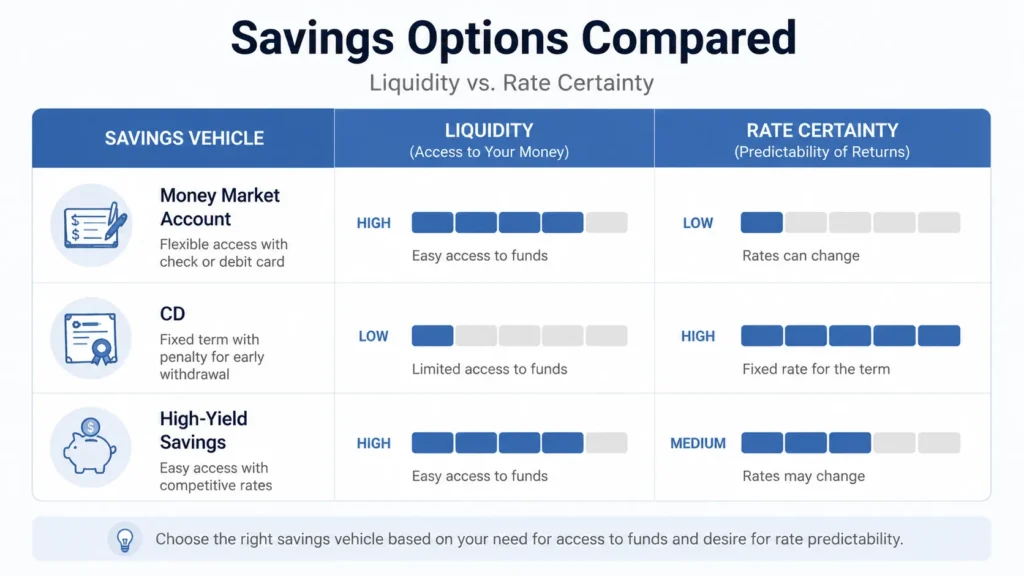
If flexibility is your priority, weigh money market accounts against high-yield savings accounts on fees, minimum balances, and any added perks like checks or a debit card. If a fixed rate and a defined end date matter more, a CD stays the stronger pick regardless of how it stacks up against savings accounts.
How Taxes Work on Each Account
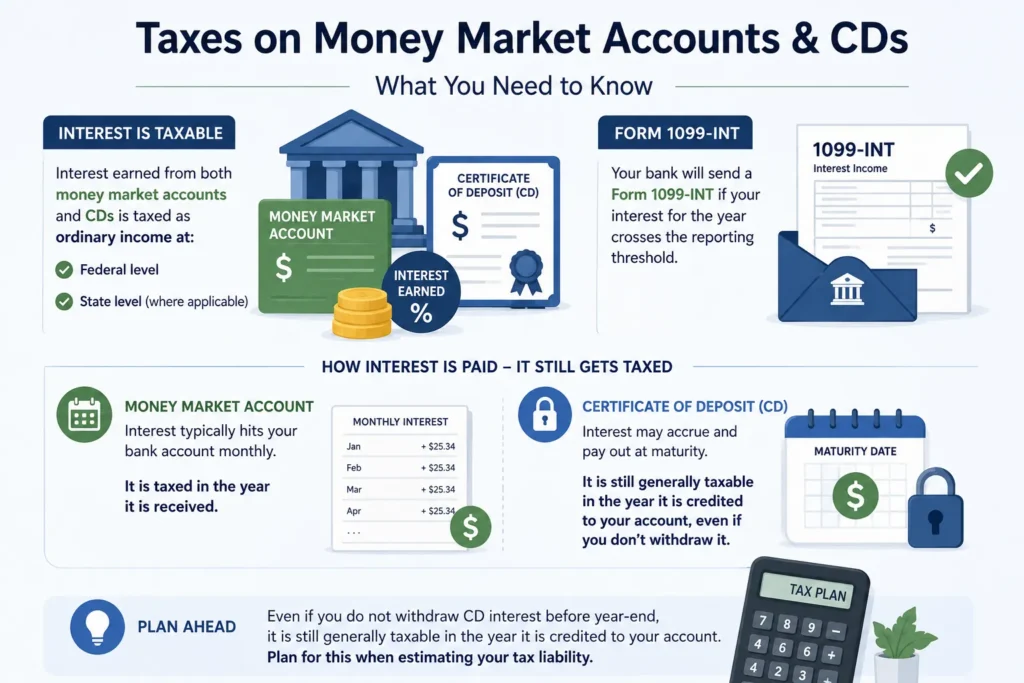
Interest from both money market accounts and CDs counts as ordinary income for federal tax purposes, and at the state level where applicable. Once your interest crosses the reporting threshold for the year, your bank sends a Form 1099-INT. This holds whether interest lands in your account monthly, as with an MMA, or accrues until maturity, as with many CDs. Even untouched CD interest is generally taxable in the year it’s credited, so factor that in when estimating what you’ll owe.