


A loan is money you borrow from a lender and agree to repay over time, usually with interest. If you are asking how loans work, here’s the short version: the lender gives you a lump sum, you make scheduled payments, and each payment covers interest first, then chips away at the balance you owe.
Almost every loan, from a $2,000 personal loan to a 30-year mortgage, follows that same pattern. This guide covers the moving parts, how interest is calculated, what lenders look at before they approve you, and the costs people tend to miss until the paperwork arrives.
The Basic Steps of Borrowing
Every loan follows the same path. You apply, the lender reviews your finances, and if you are approved, you sign a loan agreement (often called a promissory note). The note spells out the amount, the interest rate, the repayment schedule, and what happens if you miss payments.
Funds then arrive as a single payment. Some lenders deposit the money in your bank account, while others pay the seller directly, which is common with auto loans and mortgages.
From there, you repay on a schedule, most often monthly. The lender earns money from interest and fees, which is the price you pay for using their money now instead of saving up for it.
Before you sign, federal law gives you a chance to see the cost. Under the Truth in Lending Act, lenders must disclose the annual percentage rate and the total finance charge on most consumer loans, according to the Consumer Financial Protection Bureau (CFPB). Read those numbers before anything else.
Loan Terms Every Borrower Should Know
Five terms show up in nearly every loan offer. Once you know them, the rest of the process is much easier to follow.
Principal, Interest Rate, and Term
The principal is the amount you borrow. The interest rate is the percentage the lender charges for lending it, and the term is how long you have to repay, such as 36 months or 30 years.
A longer term usually lowers the monthly payment but raises the total interest you pay. A shorter term does the opposite.
APR and Collateral
The annual percentage rate (APR) folds the interest rate and certain fees into one yearly figure, which makes it a better number for comparing offers. A loan with a low interest rate and a large upfront fee can carry a higher APR than a loan with a slightly higher rate and no fee.
Collateral is an asset, such as a car or a home, that you pledge so the lender can take it if you stop paying. Loans backed by collateral are called secured loans.
How Interest Actually Gets Charged
Why Early Payments Are Mostly Interest
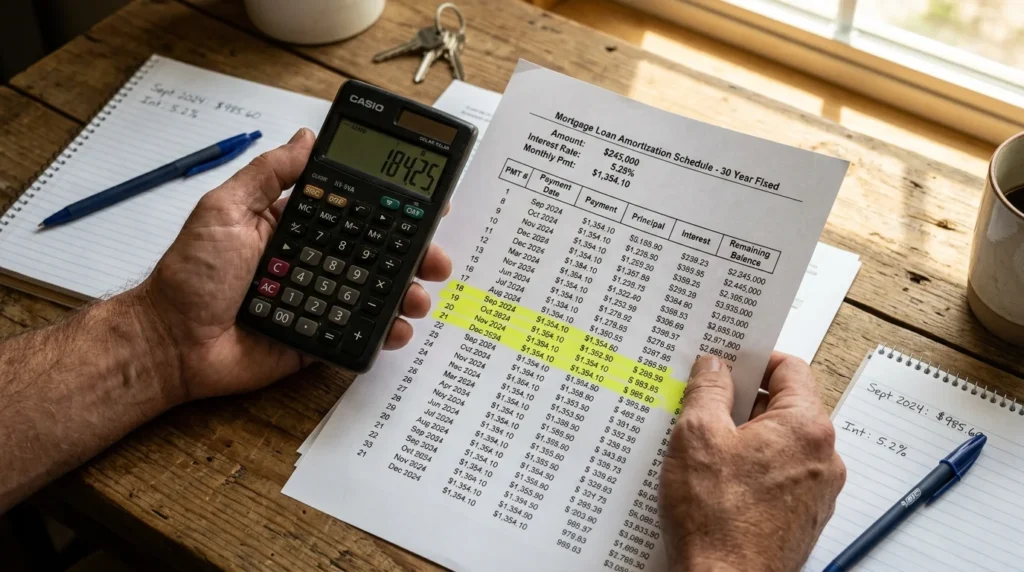
Most installment loans use amortization. Your payment stays the same each month, but the split between interest and principal shifts over time.
Interest is calculated on the remaining balance, so when the balance is highest, the interest portion is highest too. Early payments reduce the principal slowly, and as the balance falls, more of each payment goes toward principal.
A Worked Example With Real Numbers
Say you borrow $10,000 at 8% APR for 36 months. The monthly payment comes to about $313.36. In month one, roughly $66.67 of that payment is interest, and $246.69 reduces the principal.
Over the full 36 months, you would repay about $11,281, which means the loan costs roughly $1,281 in interest. Stretch the same loan to 60 months, and the payment drops to about $202.76, but total interest climbs to roughly $2,166.
These figures are illustrations, not a quote. Your own numbers depend on the lender, your credit, and the fees attached.
Fixed Rates and Variable Rates
With a fixed rate, the rate and the payment stay the same for the life of the loan. With a variable rate, the rate moves up or down with a benchmark index, so your payment can change.
Fixed rates are easier to budget around. Variable rates sometimes start lower, but you carry the risk if rates climb.
What Lenders Check Before Approving You
Lenders want to know two things: whether you can repay and whether you have a record of repaying. They answer those questions with your credit history, your income, and your existing debt.
Credit scores sit at the center of most decisions. FICO scores range from 300 to 850, and higher scores generally lead to lower rates. Lenders also compare your monthly debt payments to your monthly income, a figure called the debt-to-income ratio, and a lower ratio suggests more room in your budget for a new payment.
Income and employment history matter too. Expect to provide pay stubs, tax returns, or bank statements. Secured loans add one more step, since the lender will assess the value of the collateral.
Applying can trigger a hard inquiry on your credit report, which can lower your score slightly for a short time. Many lenders offer prequalification with a soft credit check that does not affect your score, so you can preview rates before you formally apply.
Secured Loans vs. Unsecured Loans
A secured loan is backed by collateral, so the lender has something to claim if you default. That lowers the lender’s risk, which is why mortgages and auto loans tend to carry lower rates than unsecured borrowing.
An unsecured loan has no collateral. Personal loans and most credit cards fall into this group. Because the lender has no asset to seize, approval leans more heavily on your credit and income, and rates run higher.
The tradeoff is risk to you. Miss payments on a secured loan and you can lose the car or the home. Miss payments on an unsecured loan and you can face collections, lawsuits, and credit damage.
Common Types of Loans
1. Personal Loans
Personal loans are unsecured installment loans, usually repaid over two to seven years. People use them for debt consolidation, medical bills, moving costs, or home projects.
Many lenders charge an origination fee, which is typically taken out of the loan amount. A $10,000 loan with a 5% fee puts $9,500 in your account, yet you still owe the full $10,000 plus interest.
2. Auto Loans
Auto loans are secured by the vehicle, so the lender holds a lien on it until you pay the loan off. Terms commonly run from 36 to 84 months.
Longer terms lower the payment but raise the odds of owing more than the car is worth, a situation often called being upside down.
3. Mortgages
A mortgage is a secured loan for buying a home, and the home is the collateral. The most common terms are 15 and 30 years.
Payments often include more than principal and interest. Many lenders collect property taxes and homeowners insurance through an escrow account, as the CFPB explains.

4. Student Loans
Federal student loans come from the U.S. Department of Education and carry fixed interest rates set under federal law. Terms and repayment options are listed at StudentAid.gov, and they change from time to time.
Private student loans come from banks and other lenders, and their rates depend on your credit or a cosigner’s. Federal loans also come with borrower protections that private loans usually lack.
Installment Loans vs. Revolving Credit
An installment loan gives you a fixed sum and a fixed payoff date. Revolving credit, such as a credit card or a home equity line of credit, lets you borrow up to a limit, repay, and borrow again.
With revolving credit, interest accrues only on the balance you carry, and the minimum payment shifts as that balance changes. Because a balance can linger for years, revolving credit often costs more over time than a fixed installment loan for the same purchase.
Cosigners and Co-Borrowers
A cosigner is a second person who agrees to repay the loan if you do not. Lenders accept cosigners when the main borrower has a thin credit file or limited income, and the cosigner’s stronger profile can earn a lower rate.
The arrangement carries real risk for the cosigner. The debt can appear on their credit report, and a missed payment hurts their score as well as yours. A co-borrower is different, since both people share ownership of the money and the duty to repay from the start.
Anyone who signs should understand that the lender can pursue them for the full balance.
Costs Beyond the Interest Rate
The interest rate is only part of the bill. Fees can change the true cost of a loan by hundreds or even thousands of dollars.
Origination fees come out of your loan proceeds, and late fees apply when you miss a due date. Some loans charge prepayment penalties if you pay early, though many consumer loans do not, and the CFPB advises checking your loan agreement for this term. Mortgages add closing costs on top.
High-Cost Loans and Legal Limits
Payday loans are the most expensive common option. The CFPB has noted that a typical two-week payday loan with a $15 fee per $100 borrowed works out to an APR of almost 400%.
Active-duty service members and their dependents have extra protection. The Military Lending Act caps the military annual percentage rate on most consumer credit at 36%, according to the U.S. Department of Defense.
Paying a Loan Off Early
Extra payments toward principal shorten the loan and cut total interest, because interest is charged on whatever balance remains. On the earlier $10,000 example, adding $50 to each monthly payment would clear the loan in about 31 months instead of 36 and save roughly $190 in interest.
Before you try this, confirm two things with your lender. First, check for a prepayment penalty. Second, tell the lender the extra money should go to principal, since some servicers apply it to your next scheduled payment instead.
What Happens When You Cannot Repay
Missing a payment usually triggers a late fee first. Once a payment is 30 days past due, lenders commonly report it to the credit bureaus, and negative items can stay on your credit report for up to seven years under the Fair Credit Reporting Act, per the Federal Trade Commission.
Continued default can lead to collections, a lawsuit, or repossession on a secured loan. Each step costs you more money and makes future borrowing harder.
If you see trouble coming, call the lender before you miss a payment. Many offer hardship programs or adjusted due dates. Nonprofit credit counselors affiliated with the National Foundation for Credit Counseling can also review your budget and options.
A Three-Number Check Before You Sign
Before accepting any offer, look at three numbers: the monthly payment, the total amount you will repay, and the APR. The monthly payment tells you whether the loan fits your budget. The total repaid and the APR tell you whether the loan is worth its price.
Then compare at least three offers from different kinds of lenders, such as a bank, a credit union, and an online lender. Credit unions are member-owned, and the National Credit Union Administration caps the interest rate on most federal credit union loans at 18%, which can make them a strong starting point for borrowers with fair credit.

Finally, borrow only what the purchase needs. A smaller loan with a shorter term costs less in total, as long as the payment stays comfortable on your income.