


Cash accounting records income and expenses when money actually moves. Accrual accounting records them when they’re earned or billed, regardless of when payment arrives. That single difference in timing changes how your profit looks in any given month, and which one you use can affect your taxes, your loan applications, and how accurately you understand your own business.
How cash basis accounting works
Under cash basis accounting, a sale only counts once the payment lands in your account, and a bill only counts once you actually pay it. If you invoice a client for $4,000 in October and they pay you in December, that $4,000 shows up as December income, not October income.
This method mirrors your bank balance closely, which is why freelancers, sole proprietors, and small service businesses without inventory tend to default to it. There’s no need to track accounts receivable or accounts payable, so bookkeeping stays simple. The tradeoff is that a slow month for collections can look like a loss on paper even if you did plenty of billable work.
How accrual basis accounting works
Accrual accounting records a sale the moment you earn it, not when the client pays. Using the same example, that $4,000 October invoice gets booked as October revenue, even though the cash doesn’t arrive until December. Expenses follow the same logic: a bill counts the day you incur it, not the day you pay it.
This approach follows the matching principle, which pairs revenue with the costs that generated it in the same period. A landscaping company that mows 40 lawns in a month and gets paid the following month will still show that month’s earnings correctly under accrual, even though the bank balance hasn’t caught up yet.
Cash vs accrual accounting: a side-by-side comparison
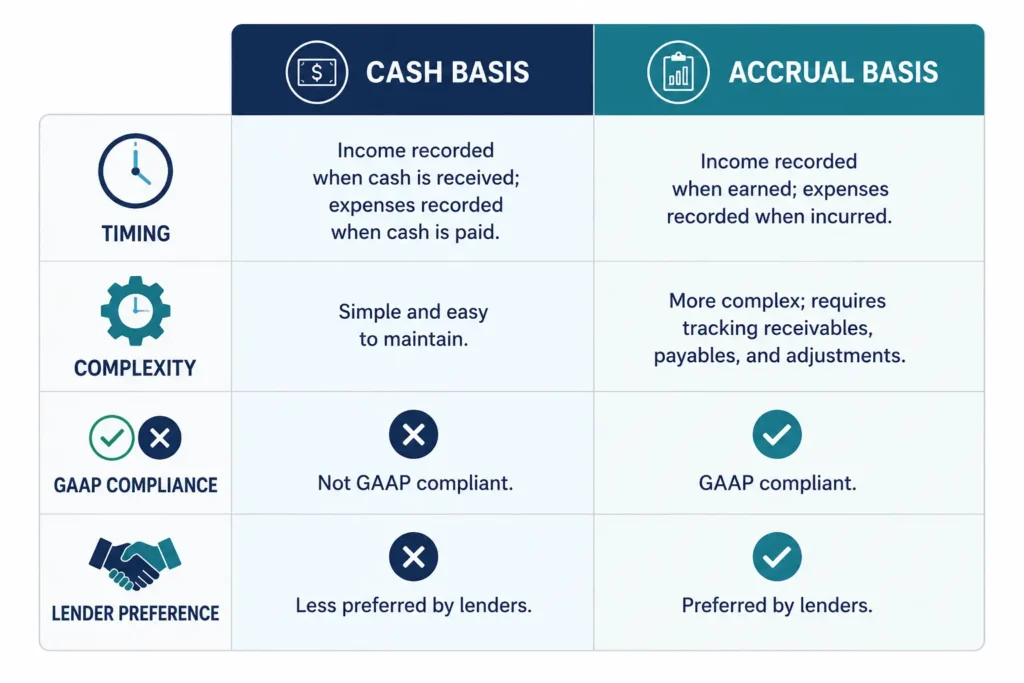
1. Timing of revenue and expenses
Cash basis ties everything to the movement of money. Accrual basis ties everything to when the work happened or the obligation was created. This is the core distinction, and every other difference between the two methods flows from it.
2. Complexity and bookkeeping effort
Cash accounting needs almost no adjusting entries; you record what hits the bank. Accrual accounting needs ongoing tracking of accounts receivable and accounts payable, plus periodic adjusting entries for accrued revenue and accrued expenses, which takes more time or more capable software.
3. GAAP and financial reporting
Generally Accepted Accounting Principles require accrual accounting for financial statement reporting. Cash basis statements aren’t GAAP-compliant, which matters if you’re preparing audited financials or reporting to a board.
4. Lender and investor expectations
Banks, venture investors, and anyone else evaluating your business from the outside will generally expect accrual-based financials, because they show earned revenue and outstanding obligations rather than just what’s in the bank right now.
Which businesses use each method
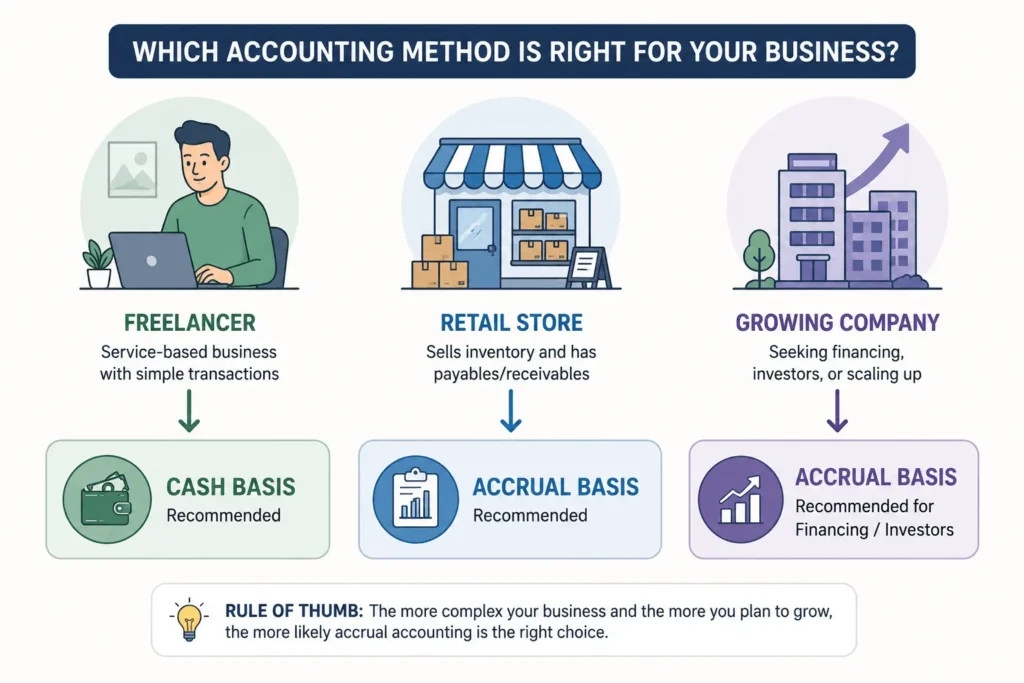
Cash basis suits sole proprietors, freelancers, and small service businesses that don’t carry inventory and collect payment quickly. If your receivables typically clear within 30 days and you have no long-term contracts, cash accounting is usually simpler without costing you much accuracy.
Accrual accounting suits businesses that carry inventory, bill on long payment terms, or plan to raise financing. A retailer that buys stock ahead of a sale needs accrual accounting to match the cost of goods sold with the revenue from selling that stock in the same period, rather than seeing costs and income land in different months.
The IRS rule on cash vs accrual accounting
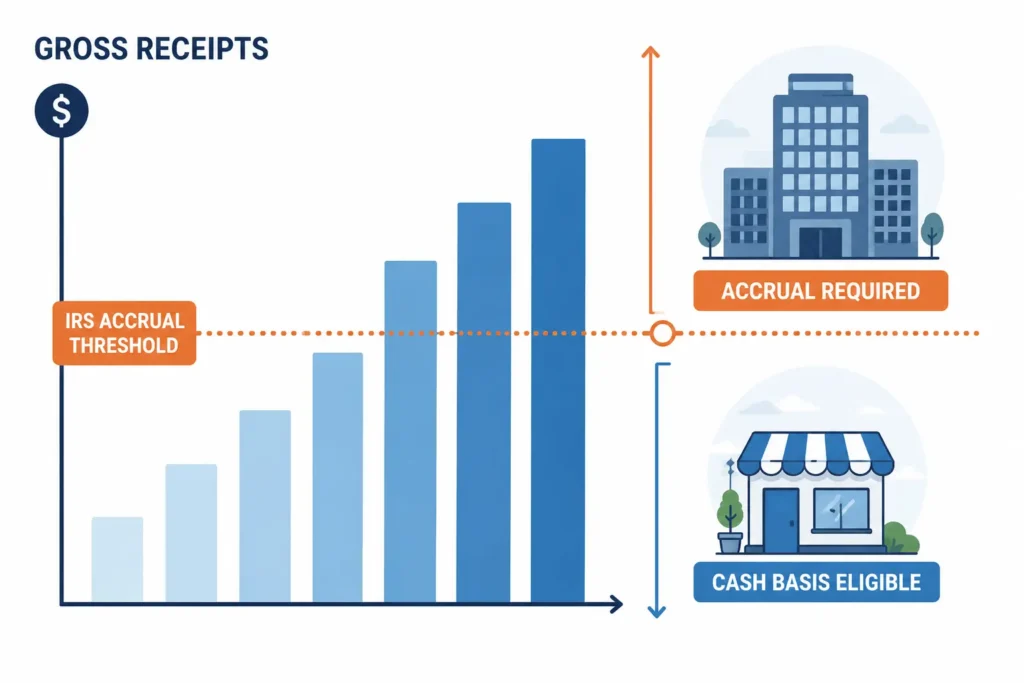
The IRS generally lets small businesses choose either method under Internal Revenue Code Section 448, but that flexibility disappears above a gross receipts threshold, which is indexed for inflation and adjusts most years. Businesses above the threshold, along with certain corporations and tax shelters, are required to use accrual accounting for tax purposes regardless of preference.
Because that dollar threshold shifts year to year, don’t rely on a number you read once online; check the current figure with the IRS or your accountant before assuming your business qualifies for the cash method.
Can you switch between cash and accrual accounting
Yes, but the IRS requires consistency once you’ve picked a method, so switching isn’t as simple as changing a setting. You generally need to file Form 3115, Application for Change in Accounting Method, and get IRS approval before the change takes effect for tax purposes.
Most accounting software, including QuickBooks and Xero, lets you toggle how a report displays between cash and accrual views without actually changing your underlying books. That’s useful for comparing both perspectives, but it isn’t the same as formally changing your accounting method with the IRS.
Modified cash basis and hybrid accounting
Some businesses use a modified cash basis, recording day-to-day transactions on a cash basis while tracking longer-term items like loans, equipment, and depreciation on an accrual basis. This gives more visibility into obligations than pure cash accounting without the full workload of accrual accounting.
A hybrid approach can also mean using accrual accounting for inventory specifically while keeping cash accounting for everything else, which some businesses use to stay compliant with inventory-matching rules without adopting full accrual bookkeeping. Neither modified cash basis nor this kind of hybrid method satisfies GAAP, so they’re a middle ground for internal use rather than a substitute for full accrual reporting when GAAP compliance is required.
How to decide which method fits your business
Start with three questions. Do you carry inventory or bill on terms longer than 30 days? Are you planning to seek a loan, investor, or audited financials in the next year or two? Are your average annual gross receipts anywhere near the IRS accrual threshold? A yes to any of these points toward accrual accounting, even if it means more bookkeeping work now.
If none of those apply and your receivables clear quickly, cash accounting is likely to serve you fine, and switching later, once your business grows into needing accrual, is a normal and common transition rather than a sign you started out wrong.
FAQ’S
Q: What is the main difference between cash and accrual accounting?
A: Cash accounting records income and expenses when money changes hands. Accrual accounting records them when they’re earned or incurred, regardless of when payment happens.
Q: Which method does the IRS require for small businesses?
A: Most small businesses can choose either method, but the IRS requires accrual accounting once average annual gross receipts pass an inflation-indexed threshold; confirm the current figure with the IRS or your accountant, since it changes over time.
Q: Is cash basis accounting GAAP compliant?
A: No. Generally Accepted Accounting Principles require accrual accounting for financial statement reporting, so cash basis statements don’t meet GAAP standards.
Q: Can I switch from cash to accrual accounting later?
A: Yes, but it requires filing IRS Form 3115 and getting approval, since the IRS expects you to stay consistent with your chosen method once it’s in use for tax purposes.
Q: Do lenders and investors prefer accrual accounting?
A: Generally yes. Accrual-based financials show earned revenue and outstanding obligations, which gives lenders and investors a more complete view than a cash-basis snapshot.
Q: What is modified cash basis accounting?
A: It’s a hybrid approach where day-to-day transactions are recorded on a cash basis while longer-term items like loans and depreciation are tracked on an accrual basis; it’s useful internally but doesn’t meet GAAP requirements.