


Double-entry accounting is a bookkeeping method where every transaction is recorded in at least two accounts, one debit and one credit, so the two sides always balance. It’s the standard system behind modern financial statements, used by everyone from freelancers to public companies filing with the SEC.
The Basic Idea Behind Double-entry Accounting
Every time money moves in a business, it comes from somewhere and goes somewhere else. Double-entry accounting captures both sides of that movement instead of just one. If a company spends cash to buy equipment, the transaction reduces the cash account and increases the equipment account, so the books stay in balance on their own.
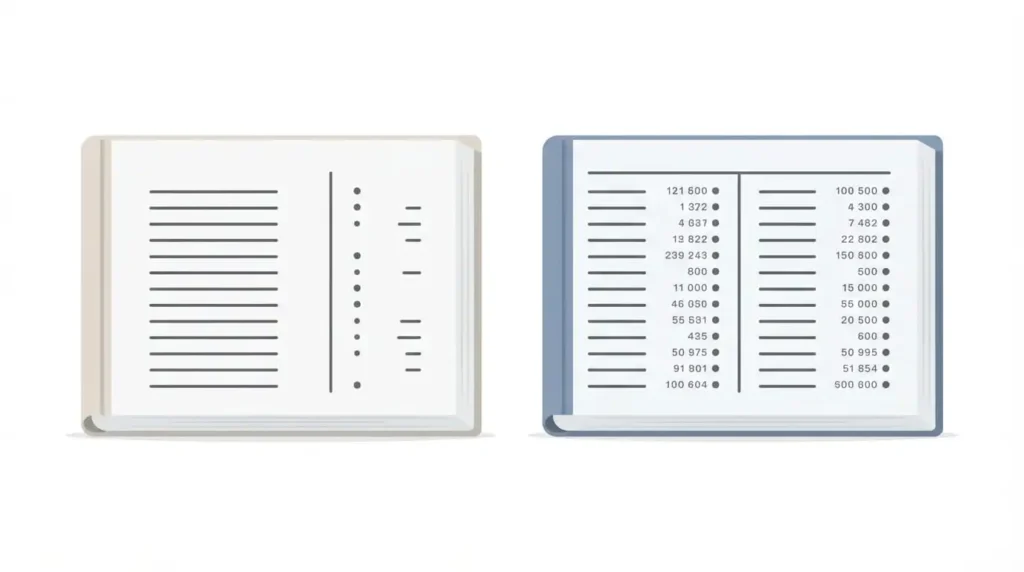
This differs from single-entry accounting, which works more like a checkbook register. You log money in, money out, and a running total, but you don’t track how a transaction affects the rest of the business. A freelancer with no inventory or debt can get away with single-entry. A business with loans, inventory, or employees usually can’t, because single-entry won’t reveal a mismatch until the damage is already done.
Where Double-entry Accounting Came From
The method isn’t new. Records from a Florentine merchant named Amatino Manucci show full double-entry bookkeeping in a ledger dated 1299 to 1300, making it one of the oldest surviving examples in Europe. The practice spread through Italian merchant cities over the next two centuries.
Credit for formalizing it usually goes to Luca Pacioli, a Franciscan friar who worked alongside Leonardo da Vinci. Pacioli published a detailed description of the system in his 1494 mathematics text, Summa de Arithmetica, which is why he’s often called the father of accounting. He didn’t invent double-entry bookkeeping, but he was the first to write it down clearly enough for merchants across Europe to copy it.
How Debits and Credits Actually Work
Debits and credits confuse a lot of people because the words don’t mean “good” or “bad.” They just describe which side of an account a number lands on. By convention, debits sit on the left side of a ledger entry and credits sit on the right.
What a debit or credit does depends on the account type:
Assets and expenses increase with a debit and decrease with a credit. Liabilities, equity, and revenue work the other way. They increase with a credit and decrease with a debit. So when a company takes out a $5,000 loan, cash (an asset) gets debited $5,000 and the loan (a liability) gets credited $5,000. Cash goes up, debt goes up, and the books stay balanced because both entries are equal in size.

The Accounting Equation That Holds it All Together
Double-entry accounting rests on one formula: assets equal liabilities plus equity. This is the accounting equation, and it has to stay true after every single transaction, no exceptions.
Think of it this way: everything a business owns (assets) was paid for somehow, either with borrowed money (liabilities) or the owner’s own investment and retained profit (equity). If a company holds $50,000 in assets and owes $30,000 in liabilities, its equity has to equal $20,000. If the numbers don’t land there, something was recorded wrong and needs to be tracked down before the books close.
This equation is also what produces the balance sheet, one of the three core financial statements alongside the income statement and cash flow statement. The name “balance sheet” comes directly from this requirement: assets always have to balance against liabilities and equity.
The Five Account Types in Double-entry Bookkeeping
Every transaction in a double-entry system gets sorted into one of five account categories, and together they make up a company’s chart of accounts.
Assets cover what a business owns and can use: cash, inventory, equipment, and accounts receivable. Liabilities cover what it owes: loans, accounts payable, and other debts. Equity represents the owner’s stake, including retained earnings and capital contributions. Revenue tracks money earned from sales or services. Expenses track the cost of running the business, like payroll, rent, and utilities.
A small retail shop, for example, might record a $1,000 inventory purchase on credit by debiting the inventory account and crediting accounts payable. Both accounts move, and the equation stays intact.
Journals, Ledgers, and Where Transactions Actually Get Recorded
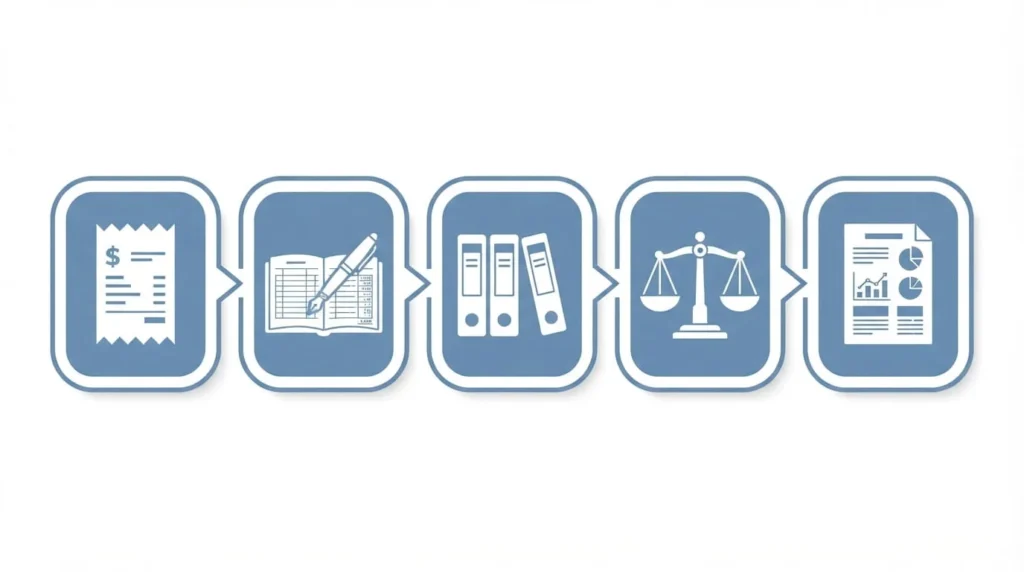
Transactions don’t jump straight into financial statements. They go through a journal first, sometimes called the book of original entry, where each entry lists the date, the accounts involved, and the debit and credit amounts. From there, the entries get posted to the general ledger, which organizes every account so balances can be tracked over time.
Periodically, usually at the end of a month or quarter, accountants run a trial balance. This is just a check to confirm that total debits across every account equal total credits. If they don’t match, there’s an error somewhere in the entries, and it needs to be found before financial statements go out.
Why Businesses Use Double-entry Accounting Instead of Single-entry
The built-in balance check is the main draw. Because every transaction hits two accounts, an error or a fraudulent entry is much easier to catch. If the debits and credits don’t match at the end of a period, someone can trace the mismatch back to its source instead of guessing where the books went wrong.
It also gives a fuller financial picture. Single-entry tracks income and expenses, but it ignores assets, liabilities, and equity. That means a business owner using single-entry might feel like they’re doing fine because cash went up, without realizing they also took on new debt that offsets it. Double-entry accounting shows both sides at once.
There’s a compliance angle too. In the United States, double-entry bookkeeping aligns with generally accepted accounting principles, known as GAAP, which the Financial Accounting Standards Board sets for public companies and lenders often expect from businesses applying for loans. Outside the U.S., a similar role is played by the International Financial Reporting Standards.
When Single-entry Accounting is Still Fine
Not every business needs full double-entry bookkeeping from day one. A freelancer with no inventory, no employees, and no debt can often manage with a simple cash log, at least early on. The moment a business takes on a loan, carries inventory, or hires staff, though, double-entry becomes the more reliable option, since it’s built to catch the kind of errors that a cash log simply can’t see.
Most accounting software defaults to double-entry now regardless of business size, so in practice, many small business owners are using the system without manually tracking debits and credits themselves.
FAQ’S
1. What is double-entry accounting in simple terms?
It’s a bookkeeping method where every transaction is recorded twice, once as a debit and once as a credit, in two different accounts. The two sides always have to be equal, which keeps the books balanced.
2. Why is it called “double-entry”?
Because each transaction creates two entries instead of one. One entry shows where the money came from, the other shows where it went.
3. What’s the difference between a debit and a credit?
A debit is an entry on the left side of an account, a credit is on the right. Whether a debit increases or decreases a balance depends on the account type: it increases assets and expenses, but decreases liabilities, equity, and revenue.
4. Do small businesses need double-entry accounting?
Not always. A freelancer or sole proprietor with simple finances can often get by with single-entry. Once a business has inventory, debt, or employees, double-entry gives a much clearer and more accurate picture.
5. What is the accounting equation?
Assets equal liabilities plus equity. Every transaction in a double-entry system has to keep this equation true, which is also what makes a balance sheet balance.