


Finance is the practice of managing, investing, and forecasting money to grow it over time. Accounting is the practice of recording, organizing, and reporting financial transactions that already happened. Finance looks forward, accounting looks backward. Together they run a business, but they solve different problems.
What Finance Actually Means
Finance is about decisions. It covers how a person, company, or government raises money, where that money should go, and how to get the best return on it. A finance professional asks questions like: should we take out a loan or issue stock, is this project worth the risk, and how much cash will we need six months from now.
Corporate finance deals with a company’s investments and capital structure. Personal finance covers budgeting, saving, and retirement planning for individuals. Public finance handles government revenue and spending. All three share the same basic job: turning limited money into better outcomes.
Here’s a concrete example. A CFO at a mid-size manufacturer is deciding whether to spend $2 million on new equipment. She builds a financial model that projects the payback period, calculates the expected return on investment, and compares it against the cost of borrowing the money. That is finance in action: forward-looking, numbers-based, and tied directly to a decision.
What Accounting Actually Means
Accounting is about record-keeping and accuracy. It tracks what already happened financially and turns raw transactions into statements that others can trust and use. Every sale, expense, payroll run, and tax payment gets recorded, classified, and eventually rolled into a report.
The main outputs of accounting are the income statement, the balance sheet, and the cash flow statement. These three documents follow rules set by the Generally Accepted Accounting Principles, or GAAP, so that numbers mean the same thing across companies and industries. Accounting splits into two branches: financial accounting, which produces statements for people outside the company like investors and regulators, and managerial accounting, which produces internal reports for company leaders.
A real-world example: a small retail business closes its books every month. The bookkeeper matches every bank transaction against the company’s records, fixes any mismatches, and produces a profit-and-loss statement. That statement tells the owner exactly how much the business earned in March, not what it might earn in the future.
Finance Vs Accounting: The Core Differences
Time Orientation: Forward-Looking Vs Backward-Looking
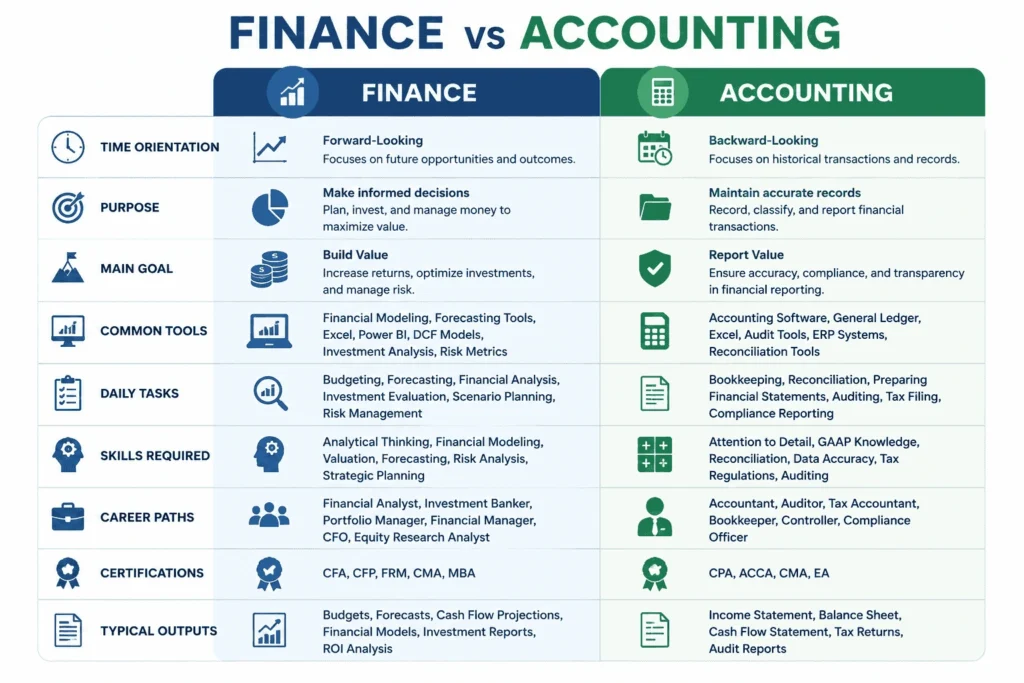
Accounting works with what has already occurred. Finance works with what could happen next. An accountant closes last quarter’s books; a financial analyst uses those same books to forecast next quarter’s cash position and decide where to allocate budget.
Purpose: Building Value Vs Reporting Value
Finance exists to grow money and manage risk. Accounting exists to record and communicate financial position accurately. A finance team might recommend cutting a product line to free up capital for a higher-return project. An accounting team’s job is to make sure the financial statements behind that decision are correct and compliant, not to make the call itself.
Key Skills And Tools
Accountants rely on GAAP knowledge, auditing standards, and tools like general ledger software and spreadsheets built for reconciliation. Finance professionals lean more on financial modeling, valuation techniques, and forecasting tools, plus a working knowledge of markets and risk. Both fields need strong Excel skills and comfort with numbers, but the day-to-day work looks different: one is about precision and compliance, the other is about judgment and projection.
Finance Vs Accounting: Careers And Salaries
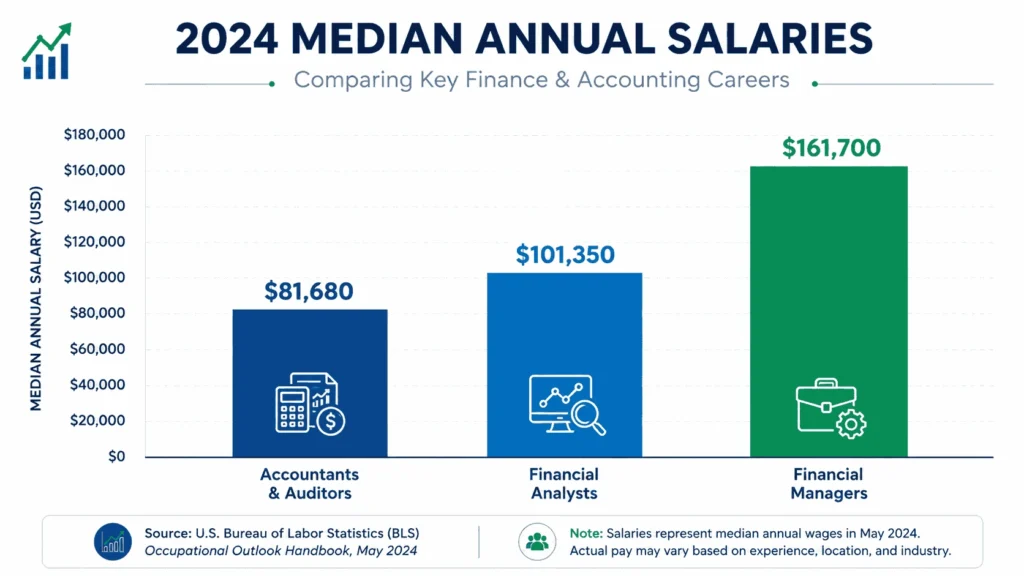
According to the U.S. Bureau of Labor Statistics, accountants and auditors earned a median annual wage of $81,680 in May 2024, with employment projected to grow 5 percent from 2024 to 2034. Financial and investment analysts earned a median of $101,350 in the same period, with 6 percent projected growth. Financial managers, a more senior role that often requires prior experience in accounting or analysis, earned a median of $161,700.
Accounting careers usually run through the Certified Public Accountant license, which requires passing the CPA exam and meeting state-specific education and experience rules. Many accountants work in public accounting firms, corporate accounting departments, or government auditing roles. Finance careers often lead toward roles like financial analyst, investment banker, or portfolio manager, and some professionals pursue the Chartered Financial Analyst designation to specialize in investment analysis. Every accounting-track role on that list eventually comes back to double-entry accounting, the core method behind how books actually get kept.
Which Degree Should You Choose?
If you enjoy precision, rules, and making sure numbers tie out exactly, accounting will likely feel like a natural fit. Coursework typically covers financial accounting, auditing, tax law, and cost accounting, and it points directly toward the CPA license.
If you’re drawn to strategy, forecasting, and deciding where money should go next, finance is the better match. Finance degrees cover corporate finance, investment analysis, and financial markets, and they lead toward analyst, banking, or advisory roles.
Neither path is objectively harder. Accounting demands patience with detail and regulation. Finance demands comfort with uncertainty and judgment calls where there’s no single correct answer. Pick based on which kind of problem you’d rather spend your career solving.
Where Finance And Accounting Overlap
The two fields depend on each other constantly. Finance decisions are only as good as the accounting data behind them. A finance team can’t forecast next year’s cash flow without accurate historical records from accounting, and an accounting team’s reports become far more useful when finance uses them to guide real decisions instead of letting them sit in a filing cabinet.
Take a small business owner running a coffee shop. Her bookkeeper handles the accounting: recording daily sales, tracking supplier invoices, and filing quarterly taxes. She uses that data herself to do the finance work: deciding whether she can afford to open a second location next year, based on projected cash flow and a loan she’s considering. Same numbers, two different jobs done with them.

The Bottom Line
Finance and accounting aren’t competing fields, they’re two halves of the same financial picture. Accounting tells you where you’ve been. Finance helps you decide where to go next. If you’re choosing a career, ask yourself whether you’d rather build the record or make the call based on it. If you’re running a business, you need both functions working together, not just one.
FAQ’S
1: Is finance harder than accounting?
Neither is inherently harder. Accounting requires close attention to detail, regulatory knowledge, and comfort with repetitive, rules-based work. Finance requires strong analytical thinking and comfort with ambiguity, since forecasts are estimates, not certainties. Your natural strengths will make one feel easier than the other.
2:Can an accountant switch to a finance career?
Yes. Many financial analysts and managers started in accounting roles, since accounting builds a strong foundation in reading financial statements. Moving into finance may require additional coursework in financial modeling, valuation, or a certification like the CFA, depending on the specific role.
3:Do I need both an accounting and finance background to run a business?
You don’t need formal degrees in both, but you need access to both functions. Many small business owners handle basic bookkeeping themselves or hire a bookkeeper, then bring in an accountant for taxes and a financial advisor or their own judgment for planning and investment decisions.
4:Which pays more, finance or accounting?
On average, finance roles like financial analyst and financial manager report higher median salaries than accounting roles, based on BLS data from May 2024. However, senior accounting roles such as controller or CFO, which often require a finance or accounting background plus years of experience, can pay comparably to senior finance positions.
5What’s the difference between financial accounting and managerial accounting?
Financial accounting produces standardized statements, like the balance sheet and income statement, for people outside the company such as investors and regulators. Managerial accounting produces internal reports, often more flexible in format, used by company leaders to make day-to-day operating decisions