


A finance major leads to jobs like financial analyst, investment banking analyst, personal financial advisor, corporate finance associate, credit analyst, and financial manager. Most entry-level roles pay between $60,000 and $95,000 a year. Pay climbs fast once you add a few years of experience or a certification like the CFA.
The Most Common Finance Major Jobs
Most finance graduates land in one of five roles first. Each one uses a different mix of the skills you picked up in school, from spreadsheet modeling to client conversations.
1) Financial Analyst
Financial analysts study a company’s revenue, debt, and cash flow, then recommend where to invest or cut costs. The median annual wage for financial and investment analysts was $101,350 in May 2024, according to the U.S. Bureau of Labor Statistics. The Bureau also projects 6 percent job growth from 2024 to 2034, with about 29,900 openings a year.
A typical week might involve pulling quarterly earnings data into a model, comparing it against three competitors, and writing a one-page recommendation for a portfolio manager. Entry-level analysts usually start under a senior analyst before running their own coverage list.
2) Investment Banking Analyst
Investment banking analysts help companies raise money or complete mergers. The job means long hours, but the pay and the learning curve are steep. A first-year analyst might build a pitch book comparing three acquisition targets, then join a call where a managing director walks a client through the numbers line by line.
3) Corporate Finance Associate
Corporate finance teams sit inside a company rather than a bank. They manage budgeting, forecasting, and capital planning for the business itself. A corporate finance associate at a mid-size manufacturer, for example, might build the annual budget for three plants and flag which one is burning cash faster than planned.
4) Personal Financial Advisor
Personal financial advisors work directly with individuals on retirement planning, taxes, and investments. The median annual wage was $102,140 in May 2024, and the Bureau of Labor Statistics projects 10 percent growth through 2034, among the fastest of any finance role. Many advisors start on a salary plus bonus structure before moving to a fee or commission model as they build a client base.
5) Credit Analyst And Risk Specialist
Credit analysts review loan applications and financial statements to judge how risky a borrower is. Risk specialists do similar work at a larger scale, measuring exposure across an entire portfolio. The median wage for financial risk specialists was $106,000 in May 2024. A credit analyst at a regional bank might review a small business loan application, check three years of tax returns, and recommend a lending limit to a loan committee.
Fintech Jobs Are Opening Up For Finance Majors
Fintech has created roles that did not exist ten years ago, and finance majors are well positioned for them because the underlying skills, reading financial statements and understanding risk, still apply.
1) Blockchain Analyst
Blockchain analysts help financial firms use blockchain technology for things like transaction tracking and fraud prevention. The role blends finance knowledge with a working understanding of how distributed ledgers function.
2) Fintech Product Manager
A fintech product manager guides the build of a financial product, say a budgeting app or a lending platform, working between engineers and the business side. Finance training helps here because product decisions often come down to how a feature affects revenue or risk.
3) Financial Data Analyst
These analysts dig through large data sets to spot spending patterns or predict market moves. A data analyst at a payments company might pull a year of transaction data to figure out why a customer segment is churning faster than expected.
Government, Nonprofit, And Unexpected Finance Jobs
Finance degrees do not lock you into banking. Universities hire finance graduates for student financial aid offices. Nonprofits need finance staff to manage grants and donor funds. Film and TV productions hire production accountants to track budgets on set, a role that uses the same cost-tracking skills as any corporate finance job, just applied to a movie set instead of a factory floor.
How Much Do Finance Major Jobs Pay
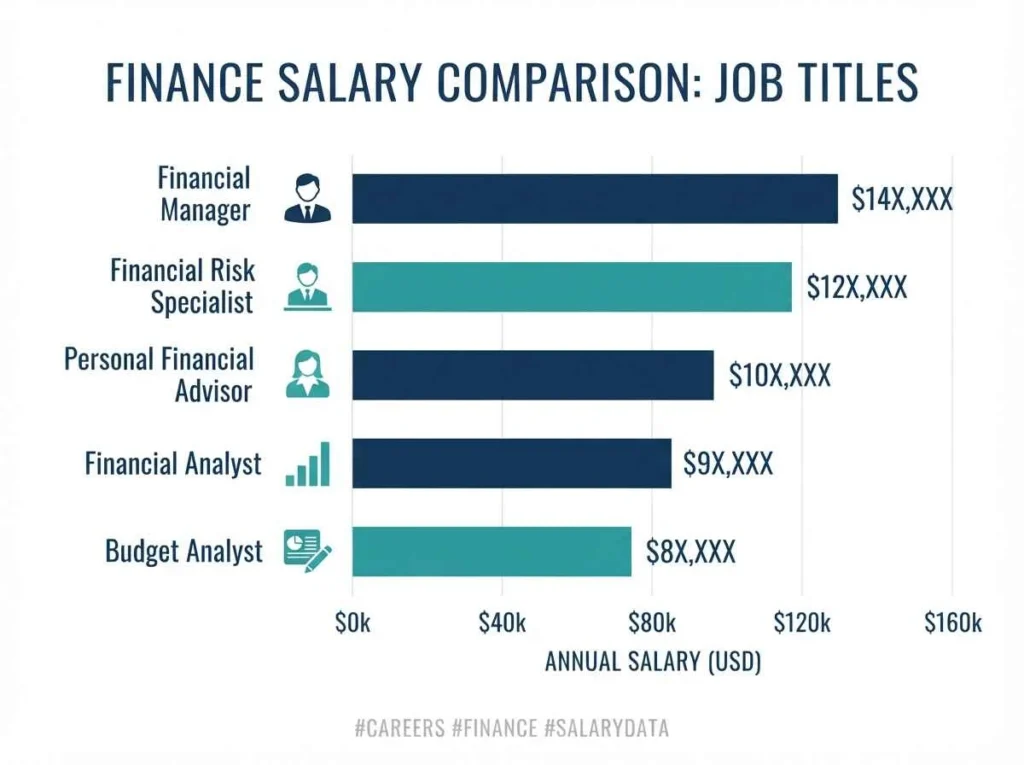
Pay varies a lot by role and location, but 2024 data from the Bureau of Labor Statistics gives a clear baseline. Financial managers earned a median of $161,700. Personal financial advisors earned $102,140. Financial and investment analysts earned $101,350. Management analysts earned $101,190. Financial risk specialists earned $106,000. Budget analysts earned $87,930. For comparison, the median wage across all U.S. occupations was $49,500 that same year, so most finance roles pay well above the national average even at the lower end.
Location moves the number too. Wages for financial analysts alone span roughly $71,000 to $158,000 depending on the city, according to BLS wage data by area, reflecting cost of living and how concentrated financial employers are in that region.
Career Progression: From Entry Level To Senior Roles
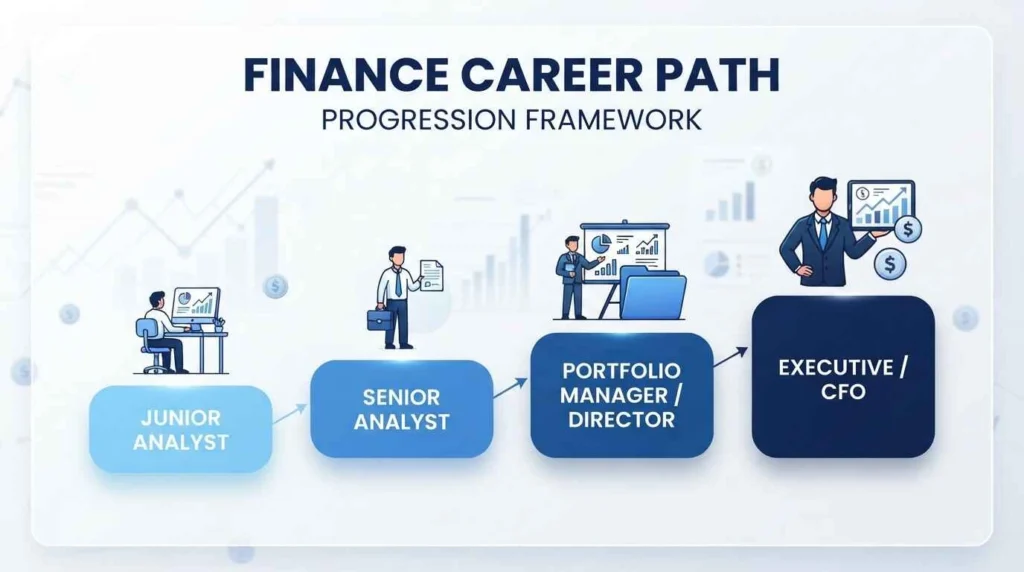
A finance career usually moves through three stages, and the jump between them depends more on experience and results than on time served.
1. Entry-Level Roles (0 to 3 Years)
This stage covers junior financial analyst, credit analyst, and staff accountant roles. The work is heavy on data entry, reconciliation, and building models under someone else’s direction.
2. Mid-Career Roles (3 to 8 Years)
Analysts move into senior analyst, associate, or portfolio manager roles. They start owning a client list or a business unit’s numbers instead of just supporting someone else’s.
3. Senior And Executive Roles (8+ Years)
Financial managers typically need a bachelor’s degree plus five or more years in another finance role, such as accountant or financial analyst, before stepping into the position. Employment for financial managers is projected to grow 15 percent from 2024 to 2034, among the fastest projections of any business occupation the Bureau tracks. From here, the path can lead to director of finance, controller, or CFO.
Several of these roles sit right on the line between finance and accounting, so it’s worth understanding how the two fields actually differ before picking a specialization.
Skills And Certifications That Help You Get Hired
Employers look for financial modeling, Excel proficiency, and the ability to explain a number to someone who is not a numbers person. A Chartered Financial Analyst (CFA) charter helps for investment roles. A Certified Financial Planner (CFP) credential helps for advisory roles. Neither is required to get your first job, but both open doors for promotions three to five years in.
Internships matter more than GPA alone. A student who spent a summer reconciling accounts at a regional bank has a concrete story to tell in an interview, something a 3.8 GPA with no internship cannot replace.
What To Do Next
If you are still choosing a path, start with a role that matches how you like to work. If you enjoy building models alone, financial analyst is a natural fit. If you like client conversations, personal financial advisor or wealth management is closer to the mark. Apply for at least one internship before your final year. It is the single fastest way to turn a finance degree into an offer.
FAQ’S
1:What jobs can I get with a finance major right out of college?
Common first jobs include financial analyst, credit analyst, staff accountant, and junior investment banking analyst. Most require a bachelor’s degree and pay between $60,000 and $95,000 to start, though banking analyst roles at large firms often pay more.
2:Is finance a good major for getting a job?
Finance graduates have steady demand because nearly every organization needs someone who understands cash flow, budgeting, and risk. Business and financial occupations overall had a median wage of $80,920 in May 2024, well above the $49,500 median for all U.S. jobs.
3:Do finance majors need to be good at math?
You need solid arithmetic and comfort with Excel, but most finance roles do not require advanced calculus. Roles like actuarial work or quantitative analysis lean harder on math than a typical financial analyst or advisor position does.
4:What pays more, finance or accounting?
it depends on the specific role. Financial managers, personal financial advisors, and financial analysts often out-earn public accountants at the same career stage, but accounting offers a more predictable path through the CPA license and a broader range of employers.
5:Can a finance major work in tech?
Yes. Fintech companies hire finance majors for product management, data analysis, and risk roles. The core skills, reading financial statements and understanding risk, transfer directly, even without a computer science background.
6:What certifications actually help a finance career?
A CFA charter helps most for investment and portfolio management roles. A CFP credential helps most for personal financial advising. Both take years to complete and are worth pursuing after your first job, not before it