


Financial advisors get paid four main ways: a percentage of the assets they manage (AUM fees), a flat annual or one-time fee, an hourly rate, or commissions on products they sell. Many combine two or more of these. The real question isn’t just how much you pay, but which model fits how you actually use an advisor.
The Four Main Ways Financial Advisors Charge
Most advisors build their business around one of these four structures, sometimes blending two. Knowing which one applies to you changes how you should read your statement and what to ask before signing anything.
Assets Under Management (AUM) Fees
This is the most common model for advisors who manage your investments on an ongoing basis. You pay a percentage of the money they oversee, usually billed quarterly and pulled directly from your account. According to Kitces Research, the median blended AUM rate is about 1% on portfolios up to $1 million, and it typically declines as your balance grows. The Envestnet | MoneyGuide 2026 State of Financial Planning Fees Study puts the industry average slightly lower, at 0.96%.
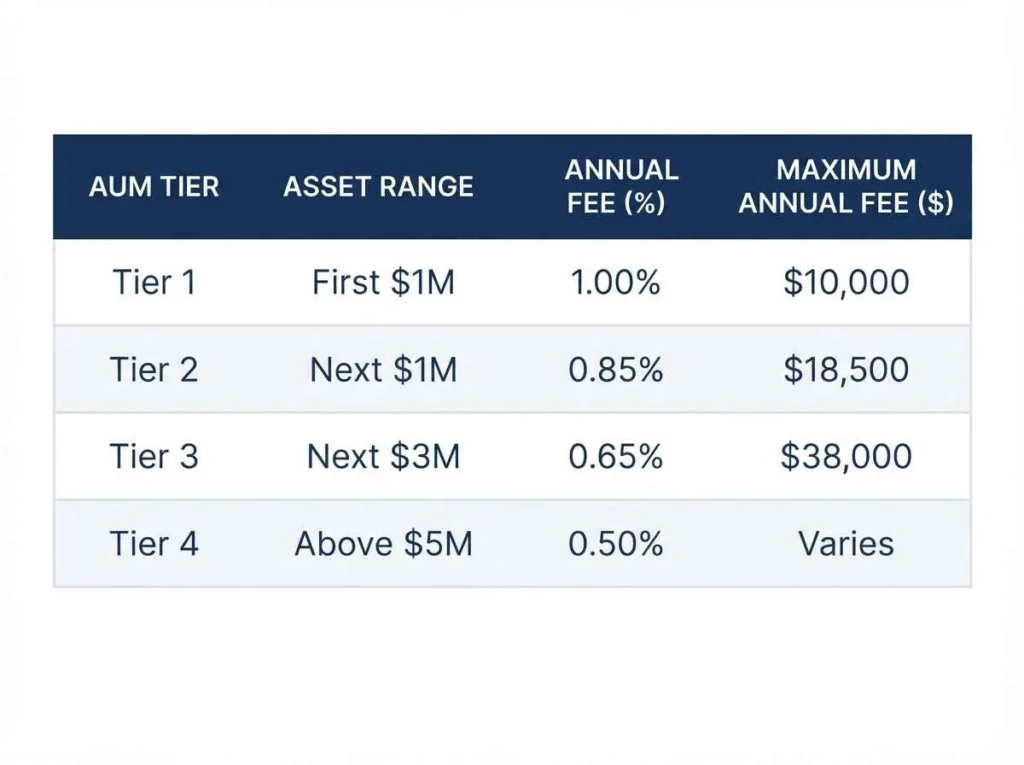
Here’s what that looks like in dollars: a $500,000 portfolio at a 1% fee costs $5,000 a year. Many firms use a tiered schedule instead. A client with $3 million might pay 1% on the first $1.5 million ($15,000) and 0.80% on the next $1.5 million ($12,000), for a blended fee of $27,000, or roughly 0.9% overall.
The fee model only tells half the story — which category they fall into also determines whether they’re legally required to act in your best interest
Flat Fees And Retainers
Flat-fee advisors charge a set dollar amount instead of a percentage, which can work out cheaper for people with large portfolios who don’t need constant trading or rebalancing. A standalone financial plan carries a median cost of about $3,000, according to a Kitces Report cited by SmartAsset. Ongoing subscription or retainer relationships cost more: industry data from Harness puts the 2026 average annual retainer at $6,815, and Envestnet reports retainer pricing has climbed sharply as more firms move toward planning-led advice rather than pure investment management.
Hourly Fees
Hourly billing suits people who want a one-time review, like checking a retirement plan or getting a second opinion, rather than an ongoing relationship. The median hourly rate is about $300, per Kitces Research, though rates commonly range from $150 to $400 depending on experience and location.
Commissions
Commission-based advisors get paid when you buy a specific product, such as a mutual fund with a sales load, an annuity, or a life insurance policy. You typically don’t see a separate invoice. The commission is built into the product’s price, which is why it’s worth asking directly what an advisor earns before you buy what they’ve recommended.
Fee-Only Vs Fee-Based Vs Commission-Based Advisors
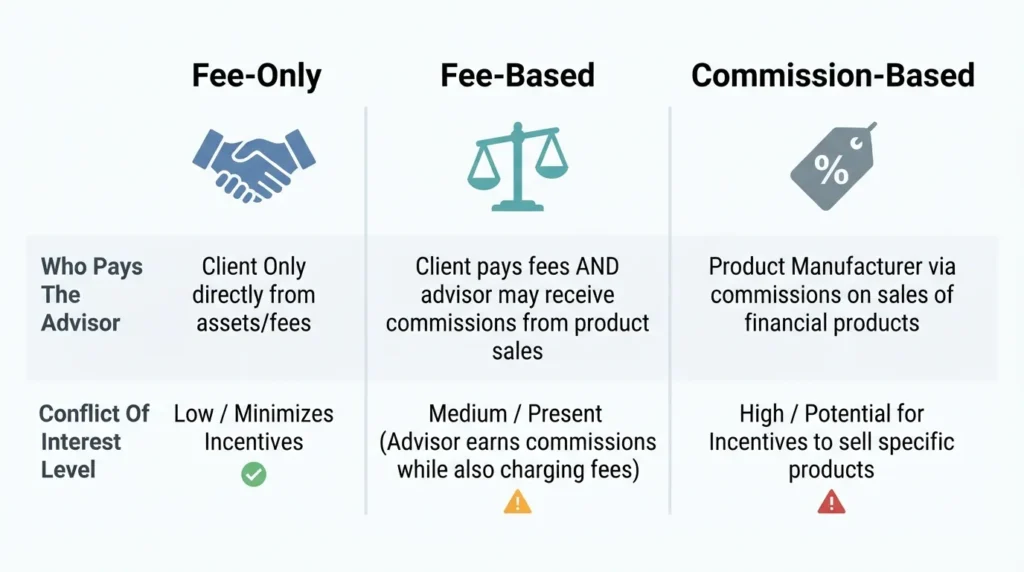
These three labels sound similar but describe different business models. A fee-only advisor is paid only by you, through AUM, flat, or hourly fees, with no commissions from product providers. A fee-based advisor blends the two: client fees plus commissions on certain products. A commission-based advisor, often a broker or insurance agent, earns money almost entirely from what they sell you.
None of these labels alone tells you whether the advice is good, but they do tell you where the incentive sits. A fee-only advisor has less reason to steer you toward a specific product, while a commission-based advisor’s income depends on you buying something.
How Much Do Financial Advisors Typically Charge
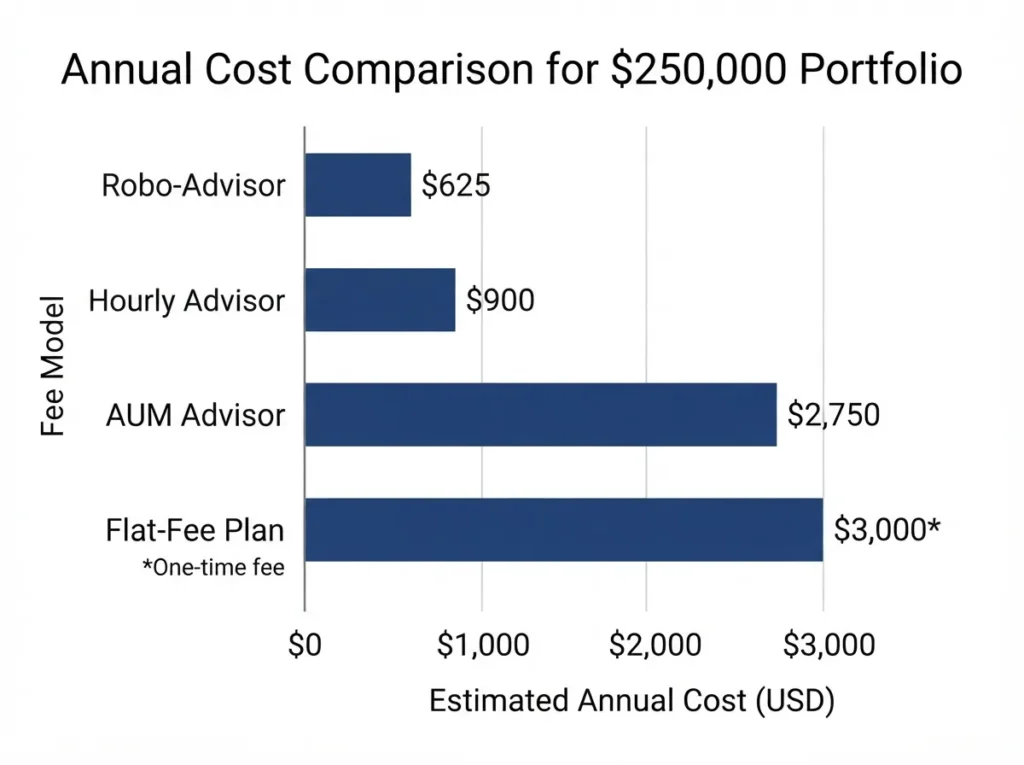
Total cost depends on which model an advisor uses and how large your portfolio is. AUM fees generally run 0.50% to 2% a year, with most falling between 0.75% and 1.5% for portfolios in the $500,000 to $1 million range, based on data from Harness and NerdWallet. Robo-advisors charge far less, typically 0.20% to 0.35% a year, per U.S. News.
A client with $250,000 through a traditional AUM advisor might pay $2,000 to $3,500 a year. The same client with a flat-fee planner might pay a single $2,500 to $3,000 charge instead, with no ongoing percentage billing. Neither option is automatically cheaper; it depends on how much ongoing management you actually need.
Fiduciary Vs Suitability: Why It Changes How Your Advisor Gets Paid
Two advisors can both call themselves a “financial advisor” and be held to different legal standards. Registered Investment Advisors (RIAs) are regulated under the Investment Advisers Act of 1940 and owe clients a fiduciary duty, meaning they’re legally required to act in your best interest at all times, including how they’re compensated.
Broker-dealers historically operated under a lower bar called the suitability standard, requiring only that a recommendation be appropriate, not necessarily the best available option. In 2020, the SEC replaced that standard with Regulation Best Interest (Reg BI), which raised the bar for broker-dealers but still permits commission structures a full fiduciary standard wouldn’t allow. A fiduciary’s compensation is legally tied to your outcomes; a broker’s is tied to the transaction in front of them.
Hidden And Indirect Costs To Watch For
The advisor’s fee isn’t always the whole story. Kitces Research found that, industry-wide, roughly 59% of a typical AUM fee pays for investment management, with the rest covering financial planning and other advice, though that split shifts depending on whether planning is bundled in. You’re also paying the expense ratios built into your mutual funds or ETFs, plus any custodial or trading costs the brokerage charges.
Commission-based products carry costs that rarely show up as a single line item. Annuities can include surrender charges for early withdrawals, and mutual funds sold with a sales load reduce your investment before it’s even put to work. Ask for the total cost of a product, not just the advisor’s fee.
How To Find Out Exactly How Your Advisor Is Paid
Every RIA must file a document called Form ADV Part 2 with the SEC or their state regulator, and give a copy to clients. It spells out the firm’s fee schedule and any conflicts of interest in plain language, and you can request it before signing anything. Ask two direct questions: are you a fiduciary at all times, not just when giving investment advice, and can you show me every fee I’ve paid over the last 12 months in writing.
Understanding how your advisor gets paid isn’t about assuming the worst of anyone in the industry. It’s about knowing which incentives are in the room before you take advice that affects your retirement or your family’s money. Ask directly, get it in writing, and compare total cost, not just the headline percentage.
FAQ’S
1. What Is The Average Fee A Financial Advisor Charges?
Most advisors managing investments charge an AUM fee averaging close to 1% a year, according to Kitces Research and the Envestnet | MoneyGuide 2026 fee study. Flat-fee plans average around $3,000, and hourly rates run about $300 an hour.
2. Do Financial Advisors Charge Fees If I Don’t Have Investments?
Yes, if they use a flat-fee or hourly model. These charge for the advice and planning itself, not a percentage of assets, which is often a better fit for people without a large portfolio yet.
3. Is A Commission-Based Financial Advisor A Bad Choice?
Not automatically, but it’s worth understanding the incentive. Since they earn money when you buy a specific product, it’s reasonable to ask what they’d earn from a recommendation and whether a lower-cost alternative exists.
4. What Does “Fee-Only” Actually Mean?
Fee-only means the advisor is paid exclusively by you, through AUM, flat, or hourly fees, with no commissions from product providers. It removes one common conflict of interest, though it doesn’t guarantee the advice fits your situation.
5. How Can I Check Exactly What I’m Paying My Advisor?
Request their Form ADV Part 2 if they’re an RIA, and ask for a written breakdown of every fee charged to your account over the past year. A transparent advisor should provide both without hesitation.