

A deductible is the amount you pay out of your own pocket before your insurance company starts paying for a covered claim. If your car repair costs $2,000 and your deductible is $500, you pay the first $500 and your insurer covers the remaining $1,500. This single number shapes how much you pay every month for coverage and how much cash you need on hand when something goes wrong.
Understanding what a deductible is matters because it directly affects two things you feel immediately: your monthly premium and your bill the day you file a claim. Pick the wrong deductible and you either overpay every month for coverage you rarely use, or you get hit with a bill you can’t cover right when you need help most.
How a Deductible Works
Every insurance policy with a deductible follows the same basic sequence. You experience a covered loss, whether that’s a car accident, a burst pipe, or a doctor’s visit. You file a claim. Your insurer checks the cost of the claim against your deductible amount.
If the claim costs less than your deductible, you pay the full amount yourself and the insurer pays nothing. If the claim costs more, you pay your deductible and the insurer covers the rest, up to your policy’s limits. A $1,000 deductible on a $600 repair means you pay the entire $600. The same deductible on a $4,000 repair means you pay $1,000 and your insurer pays $3,000.
Some policies apply a deductible once per claim. Others, especially health plans, apply it once per year across all your claims combined. Knowing which type you have changes how you budget for medical costs or repairs throughout the year.
Deductible vs. Premium: The Trade-off
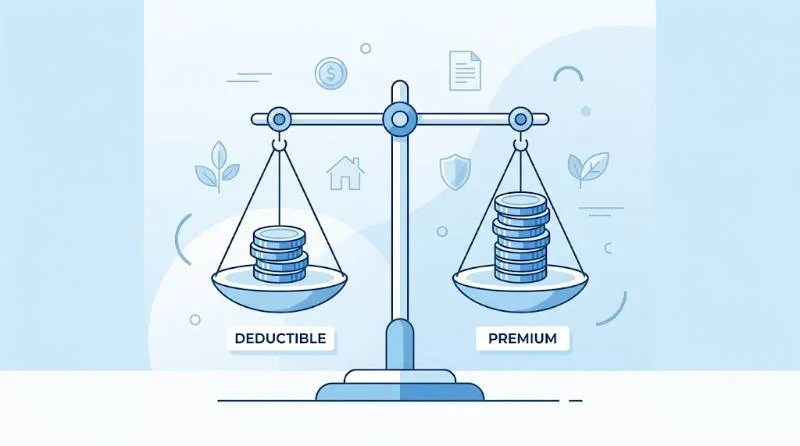
Deductibles and premiums move in opposite directions. A higher deductible almost always means a lower monthly premium, because you’re agreeing to shoulder more of the risk yourself. A lower deductible means a higher premium, since the insurer is taking on more of that risk.
This trade-off is intentional. Insurance companies price policies so that, over time, the math works out roughly the same for someone who rarely files claims. If you’re healthy, drive carefully, and rarely need to make a claim, a high deductible with a low premium often saves you money. If you expect frequent claims, such as ongoing medical treatment, a lower deductible with a higher premium can protect your budget better.
Neither option is universally correct. The right choice depends on your savings, your risk tolerance, and how predictable your expenses are.
Types of Insurance Deductibles
Not every deductible works the same way. The structure varies by policy type and even by insurer.
Fixed Dollar Deductibles
This is the most common structure. You pay a set dollar amount, such as $500 or $2,000, regardless of the total claim size. Most auto, home, and health insurance policies use fixed deductibles because they’re simple to understand and easy to budget around.
Percentage-Based Deductibles
Some policies, particularly homeowners insurance in areas prone to hurricanes, hail, or earthquakes, use a percentage-based deductible instead. Your deductible is a percentage of your home’s insured value rather than a flat dollar figure. A 2 percent deductible on a home insured for $300,000 comes out to $6,000, not a fixed number you can easily estimate without doing the math first.
Percentage deductibles catch people off guard because the dollar amount isn’t printed clearly on the policy. Always calculate what your actual dollar exposure would be before assuming your deductible is manageable.
Per-Incident vs. Annual Deductibles
A per-incident deductible resets with every separate claim. If you file two unrelated home insurance claims in the same year, you pay your deductible twice. An annual deductible, common in health insurance, applies once for the calendar year no matter how many claims you file after that point.
How Deductibles Work in Health Insurance
Health insurance deductibles work a bit differently than auto or home deductibles because they interact with several other cost-sharing tools at once.
Embedded vs. Aggregate Deductibles for Families
Family health plans often list two deductible numbers: an individual amount and a family amount. With an embedded deductible, each family member only needs to meet their own individual deductible before their claims get covered, even if the family total hasn’t been reached yet. With an aggregate deductible, the entire family must collectively hit the family deductible amount before any member’s claims are covered at the shared rate.
This distinction matters most for families with one member who needs frequent care. An embedded deductible protects that person sooner, while an aggregate deductible can delay coverage until the whole family’s combined spending catches up.
Deductibles and Out-of-Pocket Maximums
Your deductible is not the most you’ll ever pay in a year. That number is your out-of-pocket maximum, a separate and higher limit that includes your deductible plus copays and coinsurance. Once you hit your out-of-pocket maximum, your insurer covers 100 percent of covered costs for the rest of the year. Your deductible is simply the first layer of that total.

Deductible vs. Copay vs. Coinsurance
These three terms get confused constantly, so it helps to separate them clearly.
Your deductible is the amount you pay before coverage kicks in at all. A copay is a fixed fee you pay for a specific service, like $30 for a doctor’s visit, regardless of whether you’ve met your deductible. Coinsurance is a percentage split you pay after meeting your deductible, such as paying 20 percent of a bill while your insurer covers the remaining 80 percent.
Many plans use all three together. You might pay a copay for routine visits year round, then owe your full deductible before coinsurance applies to a larger procedure, then shift to coinsurance until you reach your out-of-pocket maximum.
High-Deductible Health Plans and HSAs
A high-deductible health plan, often called an HDHP, comes with a lower monthly premium in exchange for a deductible that meets or exceeds federal minimums set each year. These plans appeal to people who are generally healthy and want to reduce their monthly costs while accepting more risk for larger, less predictable medical events.
The main advantage of an HDHP is eligibility for a health savings account, or HSA. Money you put into an HSA is tax-deductible, grows tax-free, and can be withdrawn tax-free for qualified medical expenses, including your deductible itself. Unlike a flexible spending account, HSA funds roll over every year and stay with you even if you change jobs or insurers.
An HDHP makes less sense if you have ongoing medical needs, take regular prescriptions, or don’t have enough savings to cover the deductible if a major expense hits early in the year.
How Deductibles Work in Auto and Home Insurance
Auto insurance typically applies separate deductibles to collision and comprehensive coverage, and you can often choose different amounts for each. A common setup pairs a $500 collision deductible with a $250 comprehensive deductible, since comprehensive claims like theft or weather damage tend to cost less on average.

Homeowners insurance deductibles apply per claim, and many policies carry separate, often higher, deductibles for specific perils like wind, hail, or hurricanes in coastal regions. It’s worth checking whether your policy has one of these separate disaster deductibles, since it can be significantly higher than your standard deductible and easy to overlook until you actually file a claim.
Choosing the Right Deductible for Your Budget
The right deductible comes down to a simple question: how much could you comfortably pay out of pocket tomorrow if you had to file a claim today. If the answer is “not much,” a lower deductible with a higher premium protects you from a financial shock, even though you’ll pay more month to month.
If you have a solid emergency fund and want to lower your monthly costs, a higher deductible frees up cash now in exchange for more risk later. Run the actual numbers before deciding. Compare the annual premium savings of a higher deductible against the extra amount you’d owe if you filed one claim. If the savings don’t outweigh the added risk within a year or two, the lower deductible is usually the safer bet.
When Your Deductible Resets
Most deductibles reset once per year, but the reset date isn’t always January 1. Health insurance deductibles typically reset at the start of your plan year, which may follow the calendar year or your employer’s benefits cycle. Auto and home deductibles usually apply per claim rather than resetting on a schedule at all.
If you’re close to meeting your health insurance deductible near the end of your plan year, it often makes sense to schedule elective procedures or fill prescriptions before the reset, since you’ll pay less out of pocket while you’re still above that threshold.
Common Mistakes People Make With Deductibles
People frequently choose a deductible based only on the premium difference, without checking whether they could actually afford that amount if a claim happened next week. Others assume their deductible is the most they’ll pay all year, forgetting about copays, coinsurance, and separate peril-specific deductibles on home policies.

A less obvious mistake is failing to track deductible progress across a family health plan, especially with an aggregate deductible, which can lead to paying full price for services that should already be covered by that point in the year.