
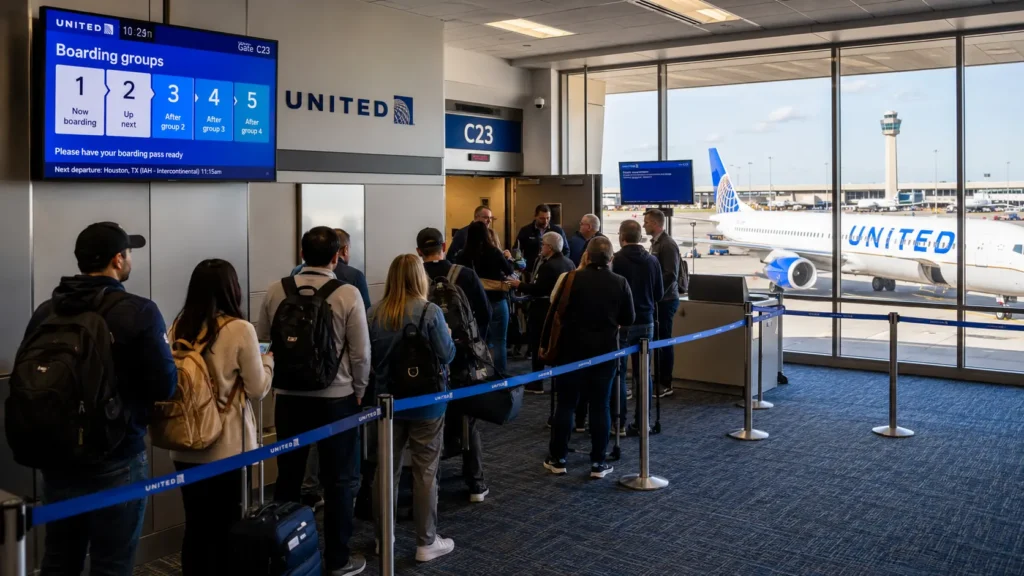

United Airlines uses seven boarding groups in total: preboarding plus six numbered groups. That number surprises a lot of travelers, since United’s boarding passes only display a single digit next to your name. The preboarding call happens before Group 1 and rarely gets mentioned out loud at the gate, so many flyers assume United only has six groups.
Knowing exactly how these seven groups work matters more than it seems. Your group determines whether you get first pick of overhead bin space, whether you’re standing in a long jet bridge line for ten minutes, or whether you’re one of the last people to squeeze down a full aisle. This guide breaks down every group, explains how United assigns you to one, and covers the specific ways to move yourself into an earlier group before your next trip.
United’s Seven Boarding Groups, Explained
United’s boarding sequence runs in this order: preboarding, Group 1, Group 2, Group 3, Group 4, Group 5, and Group 6. Each group is tied to a specific mix of cabin, fare type, loyalty status, and, in some cases, seat location. Here’s what qualifies a passenger for each one.
1. Preboarding
Preboarding comes first and is reserved for passengers who need extra time or assistance getting settled. That includes travelers with disabilities, unaccompanied minors, families traveling with small children, active-duty military members in uniform, and United’s top-tier flyers such as Global Services members and Premier 1K elites. This group is called separately from Group 1 and typically boards a few minutes before the main process begins.
2. Group 1
Group 1 covers passengers seated in United’s premium cabins, including United Polaris business class, United First, and United Premium Plus on some routes. It also includes Premier Platinum and Premier Gold elite members who aren’t already covered under preboarding. If you booked a paid business or first class ticket, you’ll almost always land in Group 1 regardless of your loyalty status.
3. Group 2
Group 2 is where most of United’s paid priority perks land. This includes Premier Silver members, passengers who purchased Premier Access or Priority Boarding as an add-on, and holders of most United co-branded credit cards, including the United Explorer Card and United Quest Card. Star Alliance Gold members flying on a partner airline also typically board in Group 2.
4. Groups 3 through 5 and the WILMA system
This is where United’s boarding process changed the most in recent years. Instead of splitting economy passengers loosely by fare class, United now boards standard economy using what’s known internally as WILMA, short for window, middle, and aisle. Group 3 boards window seat passengers first, Group 4 boards middle seat passengers, and Group 5 boards aisle seat passengers.
The logic behind WILMA is simple. When window seat passengers board first, they don’t need to stand up again to let middle or aisle passengers pass them once those groups arrive. United found this cut several minutes off average boarding time compared to the older, less structured system.
5. Group 6
Group 6 is the final numbered group and covers Basic Economy passengers who don’t qualify for any of the earlier groups through status, credit card, or add-on purchase. On domestic and select short-haul international routes, Basic Economy fares don’t include a full-size carry-on, which is part of why this group boards last. If you’re flying Basic Economy without elite status, expect to be one of the final passengers called.
Getting bumped into an earlier boarding group is often easier with a card with airport perks than by chasing status alone.”
How Does United Decide Your Boarding Group?
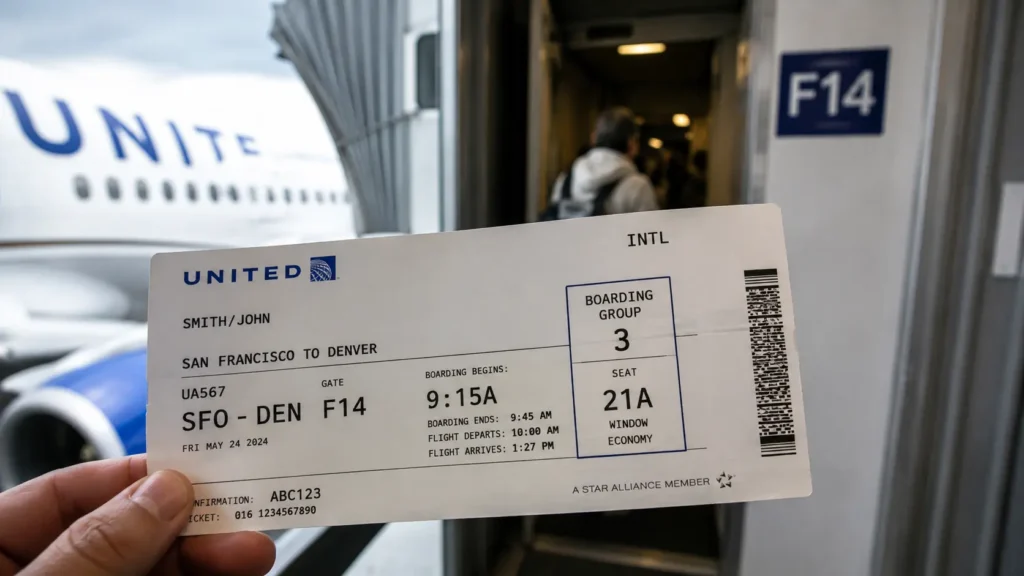
United assigns your boarding group using a combination of four factors, applied roughly in this order of weight.
Your cabin comes first. Flying in Polaris, First, or Premium Plus places you in Group 1 automatically, no matter your loyalty status. Your elite status comes next. MileagePlus Premier members are placed in earlier groups based on their tier, with Platinum and Gold members landing in Group 1 or 2 and Silver members typically in Group 2.
Your credit card matters too. United’s co-branded cards from Chase, including the Explorer, Quest, and Club cards, all come with automatic Group 2 boarding for the cardholder and companions on the same reservation. This perk applies even if you’re flying on a Basic Economy or standard economy fare, which makes it one of the more accessible ways to skip several groups without earning status through flying.
Finally, your seat location decides where you land within economy. Once you’re past Group 2, window, middle, and aisle seating determines whether you’re in Group 3, 4, or 5, assuming you don’t qualify for Group 6 as a Basic Economy passenger.
Can You Pay to Board Earlier?
Yes. United sells Premier Access and standalone Priority Boarding on most flights, and purchasing either one moves you into Group 2. Pricing varies by route and how far in advance you buy it, but it typically starts in the range of $15 to $25 per flight segment when purchased ahead of departure, and it can cost more if bought at the airport.
This is worth considering on flights where overhead bin space is a known problem, such as full flights on smaller regional jets, or on routes where you’re checking a bag and gate-side is something you’d rather avoid. It’s generally not worth the cost on flights that are unlikely to sell out, since bin space usually isn’t an issue when the plane is half full.
Basic Economy and Boarding Group 6
Basic Economy is United’s cheapest fare class, and it comes with real trade-offs beyond seat selection. Passengers booked into Basic Economy are placed in Group 6 by default, which means boarding last behind every other passenger on the aircraft. On top of boarding last, most Basic Economy fares on domestic and short-haul international routes don’t include a full-size carry-on bag, only a personal item that fits under the seat.
There are exceptions. If you hold Premier status or a qualifying co-branded credit card, you can still be moved up to an earlier group even on a Basic Economy ticket, since status and credit card perks apply on top of the fare type rather than being overridden by it. If you’re booking Basic Economy specifically to save money, it helps to plan for a longer wait at the gate and to travel light enough to fit your bag under the seat.
How to Move Up a Boarding Group
A few practical changes can shift you into an earlier group without much effort.
Applying for a United co-branded credit card is the fastest fix, since it grants Group 2 boarding immediately and applies to every flight you take, not just one trip. Earning Premier Silver status, which requires meeting United’s annual qualifying spend or flight thresholds, is a longer-term option but pays off across every flight you take that year.
For a single upcoming trip, buying Premier Access or Priority Boarding at checkout is the most direct fix. If you’re already ticketed and flying economy, selecting a window seat during check-in will place you in Group 3 instead of Group 4 or 5, which is a small but free adjustment worth making if you have a choice of seats.

Flying with a companion who has status or a qualifying credit card can also help. United generally extends the earlier boarding group to a limited number of companions traveling on the same reservation, so it’s worth booking together rather than separately when one traveler has an advantage the other doesn’t.
Where to Check Your Boarding Group
Your boarding group appears on your boarding pass once you check in, which United allows starting 24 hours before departure for most flights. You can view it in the United app, on a printed boarding pass at a kiosk, or on the mobile pass saved to your phone’s wallet app. It’s worth checking the moment check-in opens if you’re hoping for an earlier assignment, since some upgrades and complimentary status boosts are applied automatically based on availability at that time rather than guaranteed in advance.