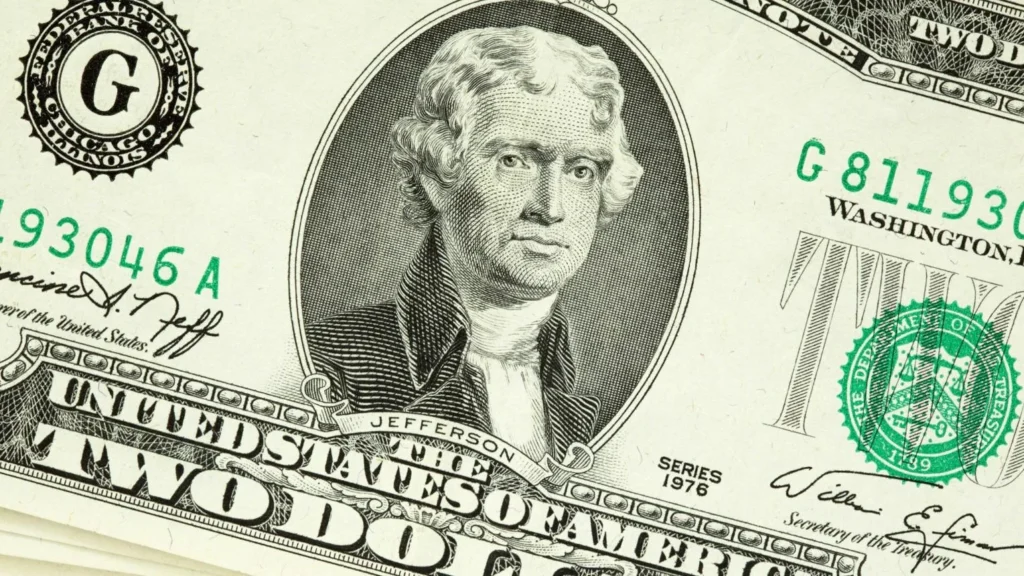

Most $2 bills are worth exactly $2, but certain examples can sell for more depending on their age, condition, serial number, seal color, and printing features. A common circulated bill from 1976 or a newer series usually has no extra collector value, while older red-seal notes, rare star notes, and unusual serial numbers may attract collectors.
If you have found a $2 bill in an old wallet, desk drawer, or family collection, check its series date and serial number before spending it. These details can help you determine whether it is ordinary currency or a collectible worth keeping.
How Much Is a $2 Bill Worth Today?
The value of a two-dollar bill depends on which series you have and how well it has been preserved. Modern circulated notes are generally worth face value, while older or unusual bills may sell above that amount.
| Type of $2 Bill | Approximate Value |
| Common circulated modern $2 bill | $2 |
| Circulated 1976 bill | Around $2 |
| Crisp, uncirculated modern bill | Around $3 to $5, sometimes more |
| 1953 or 1963 red-seal bill | Often several dollars or more |
| 1928 red-seal bill | Often above face value |
| Star note | Depends on series, printing run and condition |
| Rare serial-number bill | Potentially much higher |
| Major printing-error bill | Depends on the error and authenticity |
These are general estimates, not guaranteed selling prices. Collector demand, condition, rarity, and recent completed sales can change the price. A rare example may sell for hundreds or thousands of dollars, but that does not mean every old $2 bill is valuable.
Why Are $2 Bills Considered Rare?
Two-dollar bills are uncommon in everyday transactions, which is why many people think they are rare. However, they remain official US currency, and the Bureau of Engraving and Printing has continued issuing them.
The modern $2 note was reintroduced in 1976 for the country’s Bicentennial celebration. Its reverse features a scene based on John Trumbull’s painting of the signing of the Declaration of Independence, replacing the earlier Monticello design.
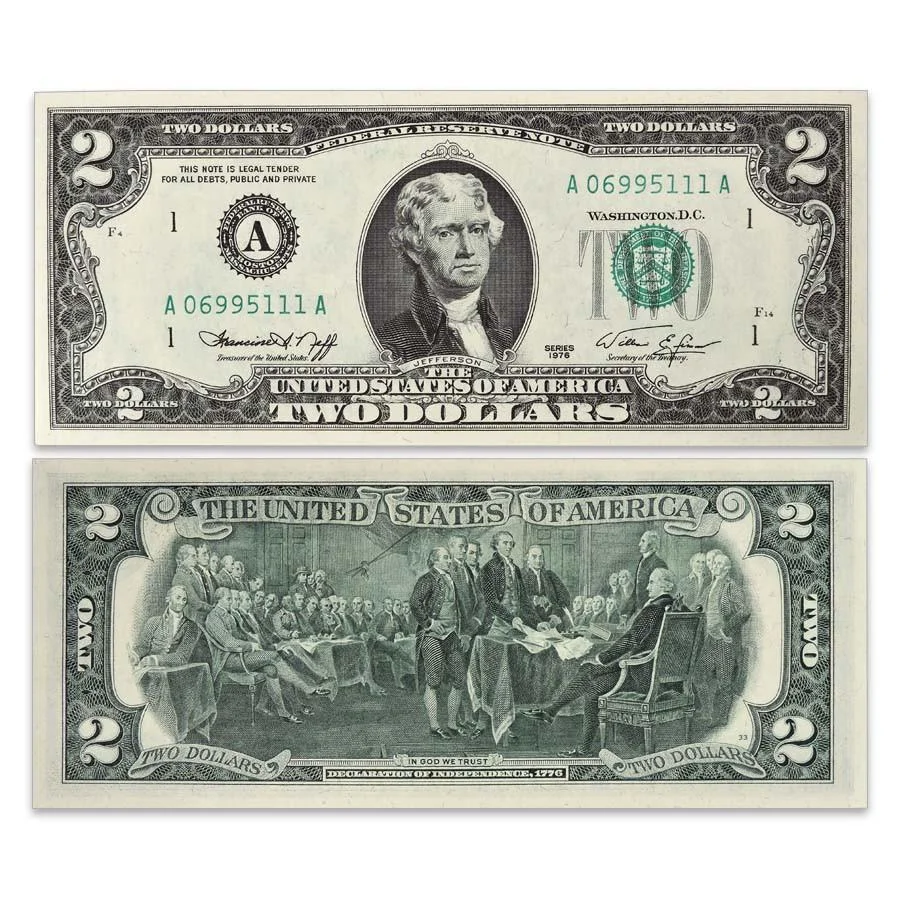
Many people saved these notes as souvenirs instead of spending them. As a result, large numbers survived in excellent condition. That is one reason a clean 1976 bill is not automatically a rare collectible.
$2 Bill Value by Year and Series
The series date printed on the bill can help you identify its type and potential collector value. Older notes generally deserve closer inspection, but age alone does not guarantee a high price.
1. 1976 and Newer $2 Bills
Most modern $2 bills have a green Treasury seal and are Federal Reserve Notes. Common circulated examples from 1976 and later generally sell for their face value.
A crisp bill with no folds, stains, tears, or heavy handling may attract a small premium from collectors. Star notes, unusual serial numbers, and genuine printing errors can also increase the price.
2. 1963 $2 Bills
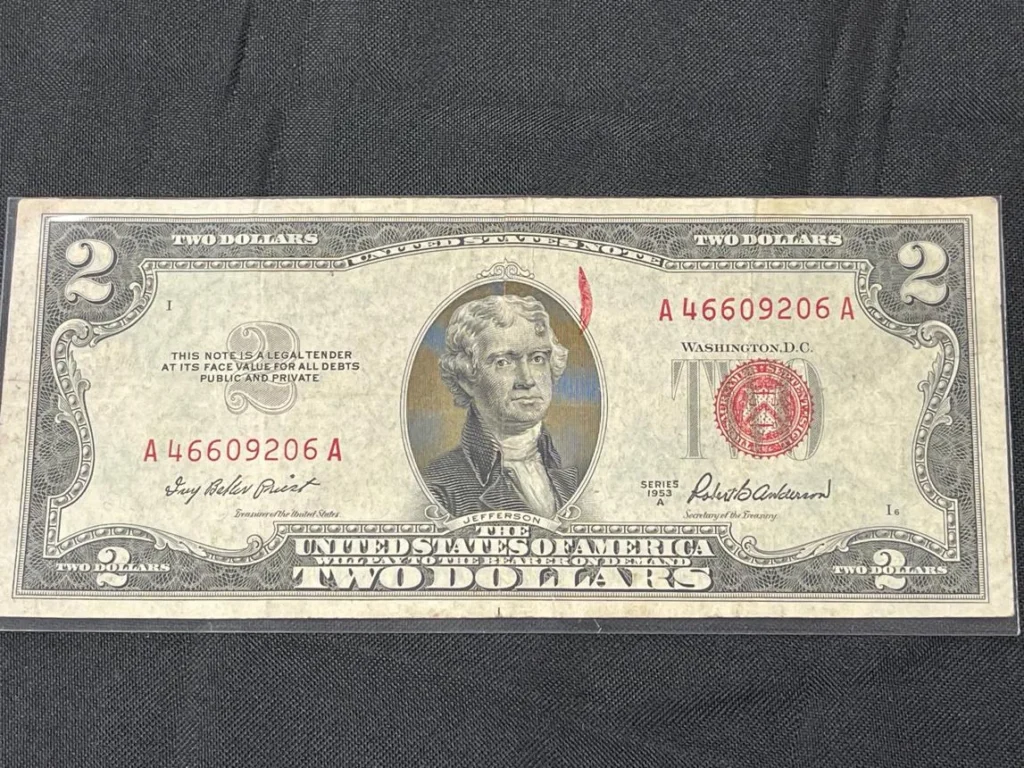
Series 1963 notes have a red Treasury seal and red serial numbers. These are older United States Notes and can be more appealing to collectors than ordinary modern green-seal bills.
Their value depends on the condition, specific series, and whether the bill has any special features. Worn examples may have only a modest premium, while crisp notes can be worth more.
3. 1953 $2 Bills
The 1953 series and its letter variations are also red-seal notes. A bill with clean paper, sharp corners, and no folds is generally more desirable than one that has spent decades in circulation.
Collectors may pay above face value for these notes, especially when the condition is excellent or the serial number is unusual.
4. 1928 $2 Bills
Series 1928 notes are older small-size bills with a red seal. Some varieties are scarcer than others, and certain series or star notes can be worth substantially more than common examples.
If you own a 1928 bill, do not judge its price based only on its age. Check the letter after the series date, the serial number, and the physical condition before deciding to sell it.
What Makes a $2 Bill Valuable?
A few specific characteristics can make a two-dollar bill more desirable to collectors.
1. Red Treasury Seal
Older red-seal $2 bills are United States Notes. Their age, series, variety, and condition may give them a collector premium. Red seals are a useful starting point when examining an older bill.
2. Star Notes
A star printed near the serial number identifies a replacement note. These notes were produced to replace currency that was rejected during the printing process.
Some star notes are common, while others come from smaller printing runs. The series, Federal Reserve district, print run, and condition all matter, so the star alone does not guarantee a high value.
3. Rare Serial Numbers
Collectors sometimes look for unusual serial-number patterns, including:
- Very low numbers, such as 00000001 or 00000010
- Repeating numbers, such as 77777777
- Ladder numbers that run in sequence
- Radar numbers that read the same forward and backward
- Solid serial numbers made up of the same digit
The rarity and desirability of the pattern can make a bill more attractive. However, not every unusual-looking number is worth a large premium.
4. Printing Errors
Authentic printing errors can add collector value. Examples include misaligned printing, unusual ink problems, missing printing elements, or other production mistakes.
Before assuming an error is valuable, have it checked by a knowledgeable currency dealer or grading service. Damage from folding, washing, ink marks, or everyday handling is not the same as a genuine printing error.
How to Check if Your $2 Bill Is Valuable
You can perform a basic inspection at home before contacting a collector.
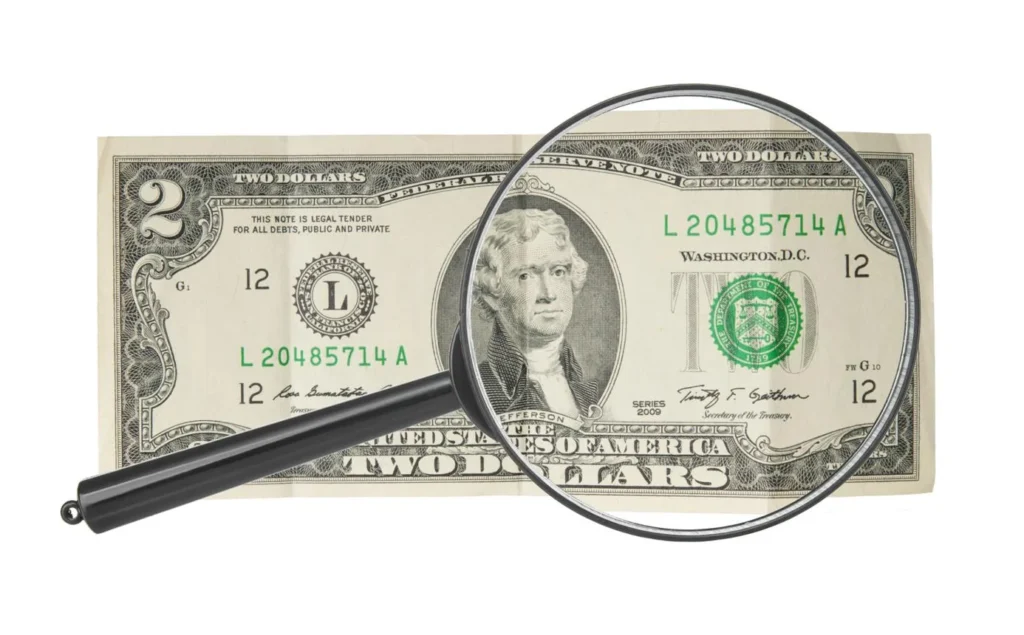
- Check the series date. Look near Thomas Jefferson’s portrait to identify the printed series.
- Look at the Treasury seal. A green seal usually indicates a modern Federal Reserve Note, while red seals identify older United States Notes.
- Inspect the serial number. Look for a star, very low numbers, repeated digits, or recognizable patterns.
- Examine the condition. Check for folds, stains, tears, fading, rounded corners, and other damage.
- Compare completed sales. Look at recently sold examples of the same series and condition, not just the prices sellers are asking.
A bill that looks old may still be common. Matching your note to the correct series and condition is a better way to estimate its market value.
Where Can You Sell a Valuable $2 Bill?
If your bill appears collectible, you can compare selling options before accepting an offer. Local coin and currency dealers can inspect it in person, while online marketplaces may help you reach a larger audience.
For potentially rare notes, professional grading may help buyers understand the condition and authenticity. However, grading fees may not make sense for an ordinary $2 bill worth only face value.
Check several completed sales for comparable notes and avoid rushing into a deal simply because someone claims your bill is rare. A realistic price estimate should be based on the exact series, condition, and documented selling prices.
Should You Keep or Spend Your $2 Bill?
If your bill is an ordinary modern note with no special serial number or unusual features, spending it for $2 is usually reasonable. If it is an older red-seal note, a star note, an exceptionally crisp bill, or one with an interesting serial number, it may be worth investigating before spending it.
The best answer to how much a $ 2 bill is worth is usually its face value, but checking the series date, seal, condition, and serial number can help you spot the exceptions that collectors may want to buy.