
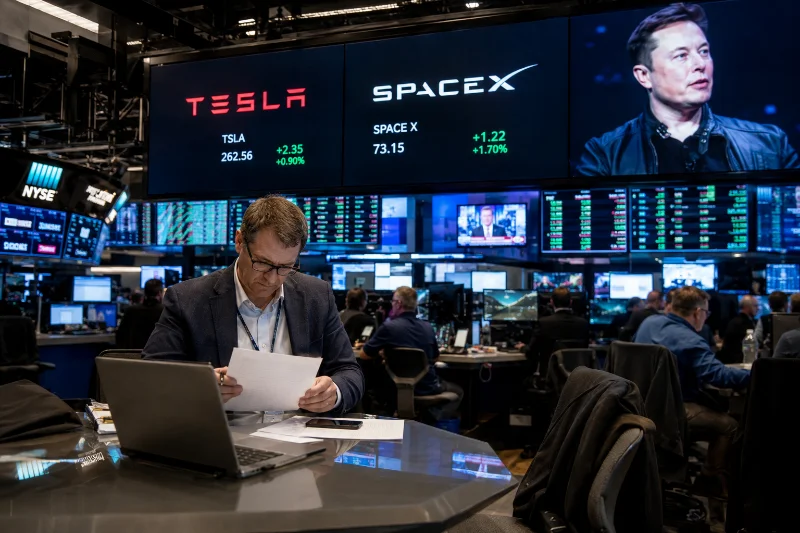

Based on his net worth growth since he first became a billionaire, Elon Musk has added roughly $2,500 to his fortune every second. That is not a salary. Musk draws no regular paycheck from Tesla, so the number is a rough average of how fast his stock holdings have grown in value since 2013, not cash landing in a bank account.
That average also hides enormous swings. In some months his wealth has fallen by billions in a single afternoon. In June 2026, it jumped by more than $200 billion in a matter of days. Understanding both sides of that story is the only way the per-second figure actually means anything.
A Quick Look at How He Got Here
None of this happened overnight, and it did not happen in a straight line either. Musk’s first real windfall came in 1999, when he sold the online publishing company Zip2 for roughly $300 million, pocketing around $22 million himself. He rolled much of that into X.com, which merged into PayPal, and when eBay bought PayPal in 2002 his stake was worth close to $180 million.
He put most of that money straight back into Tesla, SpaceX, and SolarCity rather than banking it. By 2008, both Tesla and SpaceX were close to running out of cash, and it took last-minute funding rounds and a NASA contract to keep either company alive. That near-collapse is worth remembering, because it means the fortune being measured in dollars per second today was built from a starting point close to zero less than two decades ago.
Where the $2,500-a-Second Figure Comes From
Bloomberg first classified Musk as a billionaire in June 2013, when it put his fortune at roughly $6.4 billion. As of July 1, 2026, Forbes placed his net worth at approximately $1.053 trillion. Divide the gain between those two points by the number of seconds that have passed, and you land on a long-run average of about $2,500 per second.
That figure is a convenient way to grasp a number too large to feel real. It is not how Musk is actually paid, and it is not steady. Tesla’s own proxy filings confirm he has taken no base salary from the company for years. His wealth is almost entirely unrealized paper value tied to shares he still holds.
Why He Has No Paycheck But Still Gets Richer
Musk’s fortune moves with the share prices of the companies he owns stakes in, mainly Tesla and, since June 2026, SpaceX. When those stocks rise, his net worth rises with them, on paper, whether or not he sells a single share.
The one payout that comes closest to a traditional paycheck is Tesla’s 2018 performance award. The board approved a stock option package worth up to $55.8 billion, but it only vests if Tesla hits a series of escalating market capitalization and operational targets. It is a bet on future performance, not a monthly wage.
Most of the rest of his wealth sits in private holdings such as SpaceX, xAI, and Neuralink, which get repriced only when a new funding round or, as happened in 2026, a public listing sets a fresh valuation.
There is also an important catch that most quick summaries skip. A large share of Musk’s Tesla shares are pledged as collateral against personal loans, and the huge restricted stock awards from his pay packages cannot be sold on the open market at all. Selling any meaningful block of shares would also push the price down against him. So while the net worth figure is real in the sense that it reflects what the market says his holdings are worth, it is not a pile of cash sitting in an account that he could spend at will.

The SpaceX IPO Pushed Him Past $1 Trillion
The single biggest jump in Musk’s fortune this year came on June 12, 2026, when SpaceX went public on the Nasdaq. The offering priced at $135 a share, raising roughly $75 billion and pushing SpaceX’s valuation near $1.77 trillion. Musk’s roughly 38 percent stake, once a private holding that was hard to value precisely, was repriced almost overnight.
Forbes reported his net worth rose by $188 billion in the single day the IPO priced, then climbed further once trading began, crossing $1 trillion and making him the first person in recorded history to hold a twelve-figure fortune.
By July 1, 2026, Forbes had his total holdings at about $1.053 trillion, with roughly $218 billion of that gain arriving in the previous 30 days alone, most of it tied directly to the IPO rather than ordinary day-to-day trading.
Breaking the Number Down by Time
Two different questions get asked interchangeably, and they produce very different answers. One is “what has Musk’s average rate of wealth creation been since he became a billionaire.” The other is “how fast is his fortune growing right now.” Both are worth showing side by side.
Long-run average (2013 to mid-2026):
| Time Period | Approximate Amount |
| Per second | $2,500 |
| Per minute | $150,000 |
| Per hour | $9 million |
| Per day | $216 million |
June 2026 snapshot (SpaceX IPO month):
| Time Period | Approximate Amount |
| Per second | $84,000 |
| Per minute | $5 million |
| Per hour | $302 million |
| Per day | $7.3 billion |
The second table is not a sustainable pace. It reflects a one-time repricing event when a private company suddenly started trading in public markets. Most analysts who track his fortune expect the growth rate to flatten in the second half of 2026 now that SpaceX and Tesla shares will move the way any other public stock does, in both directions. A number that large only means something in context — here’s how that stacks up against the total money in circulation worldwide.

What That Looks Like Next to a Regular Paycheck
The U.S. Bureau of Labor Statistics put median weekly earnings for full-time American workers at $1,235 in the first quarter of 2026, or about $64,220 a year. At Musk’s long-run average of $2,500 a second, he earns that same annual figure in roughly 26 seconds.
During the SpaceX IPO stretch, when his fortune was growing closer to $84,000 a second, that same typical American salary passed by in well under one second. Neither comparison is meant to suggest the two figures are earned the same way. One is realized wages from work performed. The other is the market’s constantly shifting opinion of what Musk’s shares are worth, and it can just as easily run in reverse.
Musk has already experienced that reversal firsthand. Guinness World Records has recognized a stretch in his history as the largest single loss of personal wealth ever recorded, when a stock slide wiped out tens of billions of his net worth in a matter of months. Same math, same method, opposite direction.
It also helps to compare Musk’s pace against other people near the top of the wealth rankings rather than only against a typical salary. Bernard Arnault and Jeff Bezos have both added and lost tens of billions in single stretches too, since their fortunes are similarly tied to a small number of stock positions rather than diversified, steady income. What sets Musk apart in 2026 is simply the size of the base those swings are now applied to. A five percent move in a $1 trillion fortune is worth far more in raw dollars than the same percentage move was worth a decade ago, even if the underlying volatility is nothing new for a founder-CEO whose wealth rides almost entirely on the companies he runs.
If You Want to Watch the Number Move
A handful of sites keep live counters that update Musk’s estimated net worth by the second, pulling from Tesla and SpaceX share prices as they change throughout the trading day. Trackers like the one on Stats-Panda break the running total down by minute and hour, and interactive tools such as Spend Elon-Musk money let visitors play with the full sum as a kind of spending simulator to get a feel for the scale involved. Treat any second-by-second counter as an estimate rather than an exact figure. Even Forbes and Bloomberg, which each maintain their own real-time billionaire trackers, differ from each other by tens of billions of dollars at any given moment, because they weigh private holdings slightly differently.
What all of the trackers agree on is the shape of the story: a fortune built almost entirely from equity in a handful of companies, no fixed salary behind it, and a growth rate that can swing from tens of thousands of dollars a second down to a steep loss depending entirely on what the stock market decides Tesla and SpaceX are worth that day.