
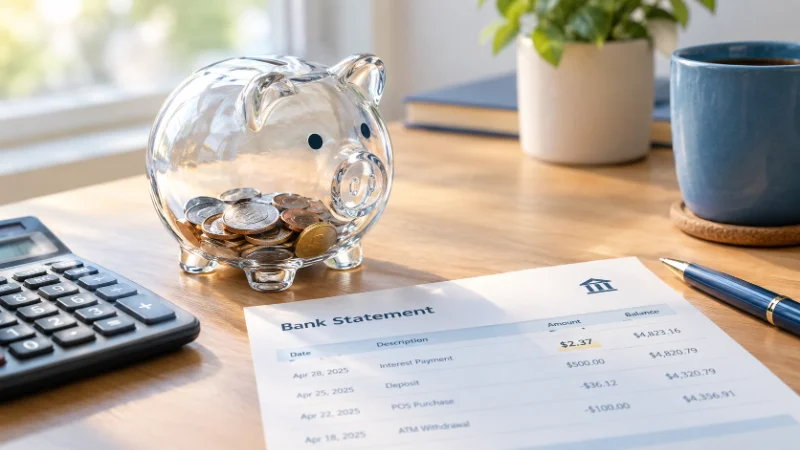

Which savings account will earn you the least money? The answer is a standard savings account at a large, branch-based bank. Many of these pay 0.01% APY. On a $10,000 balance, that is about $1 of interest in a full year. The FDIC’s national average savings rate was 0.38% in August 2026, and competitive online accounts paid around 4%. This guide explains why some accounts pay so little and how to fix that without taking on risk.
Which Savings Account will Earn You the Least Money in Practice
The lowest earner is the basic savings account bundled with a checking account at a big national bank. You open it at a branch, link it to your checking, and forget about it. The rate is often 0.01%, and it rarely changes.
These accounts are not scams. They are insured, easy to reach, and handy for overdraft protection. The cost is the interest you give up for that convenience.
Two other products also tend to land near the bottom. Interest-bearing checking accounts usually offer token rates. Savings accounts with a high minimum balance can pay nothing if your balance dips below the line.
Low rates are not limited to big banks. Some online banks and credit unions also pay near-zero rates on basic accounts. A few high-yield accounts drop their rates after a promotion. The bank’s name does not guarantee the rate.
Why Big Banks Pay so Little on Savings
Banks pay you interest because they lend your deposits out at higher rates. The gap between what they earn and what they pay is their profit. A big bank with thousands of branches already has plenty of deposits from loyal customers. It has little reason to compete for yours.
Online banks work differently. They have no branches to maintain, so they can pass part of that saving on as higher rates. They also want your deposit more, because deposits are their main source of funding.
The Federal Reserve’s policy rate sets the general direction. When the Fed raises rates, online banks tend to follow quickly. Large banks often lag behind or barely move. That is why a 4% account and a 0.01% account can exist side by side.
There is one exception. Some large banks run premium savings tiers that pay more for big balances. You usually need to hold a large combined balance with the bank to qualify.
What a Low Savings Rate Costs you in Real Dollars
Percentages hide the damage. Dollars show it. Here is what $10,000 earns in one year at different rates.
- 0.01% APY, a typical big-bank savings rate: about $1
- 0.38% APY, the national average: about $38
- 1.71% APY, the average 12-month CD: about $171
- 4% APY, a competitive high-yield account: about $400
Over five years, the gap widens. The big-bank account adds roughly $5. A high-yield account at a steady 4% adds more than $2,100. Rates change, so treat that as an illustration, not a promise.
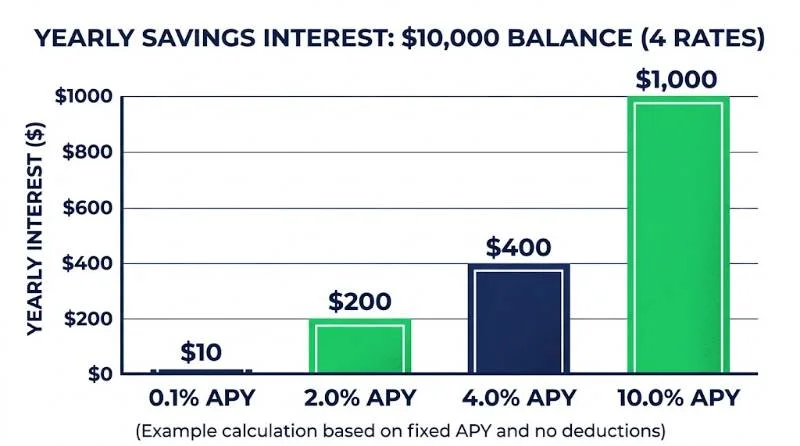
Now picture a $25,000 emergency fund. At 0.01%, it earns $2.50 a year. At 4%, it earns about $1,000. Leaving that cash in the weakest account costs you roughly $1,000 a year.
The difference does not come from risk. Both accounts carry the same federal insurance, as long as the banks are insured.
Savings Products Ranked From Lowest to Highest Earning
1: Basic Savings at a Large Bank
These pay the least. Many branch-based banks offer between 0.01% and 0.10% APY. Some pay a bit more if you keep a large combined balance with the bank.
2: Interest-Bearing Checking
Rates are tiny, and many accounts require debit card swipes or direct deposits. Miss the requirement and the rate drops to near zero. These accounts are for spending, not saving.
3: Money Market Accounts
The national average money market rate was 0.63% in August 2026. That beats basic savings. Many come with check-writing and a debit card. Online money market accounts often pay much more than the national figure.
4: Certificates of Deposit
The average 12-month CD paid 1.71% nationally in August 2026. Top CDs pay more. The trade-off is an early withdrawal penalty, so CDs suit money you will not need soon.
5: High-Yield Savings Accounts
This is not a separate product type. The label describes any savings account that pays far above average. Online banks and some credit unions offer them. Many pay around 4% APY with no monthly fee, and your money stays available.
Hidden Factors That Make a Savings Account Earn Even Less
A low rate is only part of the story. Several quieter factors can push your return lower still.
Monthly fees do the most damage. A $5 monthly fee costs $60 a year. On a $300 balance earning 0.01%, that fee dwarfs the interest, so the account loses money. Many banks waive the fee if you keep a minimum balance or link a checking account.
Balance tiers matter too. Some accounts pay interest only above a set balance, and the best rate may start at a higher tier. If you sit below the first tier, you may earn nothing.
Withdrawal rules can cost you. Some accounts charge a fee after a set number of withdrawals each month. If you pull money often, the fees can exceed the interest.
Promotional rates fade. A rate that looks strong for three or six months can drop to the standard rate afterward. Always check what the rate becomes once the offer ends.
Inflation is the quiet cost. When prices rise faster than your rate, your money buys less each year. No fee appears on your statement, but the loss is real.
Interest is also taxable income. At a low rate the tax bill is tiny, but it never turns a poor return into a good one.
Simple Interest vs Compound Interest: The Class Room Answer
This question often appears as a multiple-choice quiz in personal finance courses. The four options are simple interest daily, compound interest daily, simple interest monthly, and compound interest monthly. The account that earns the least is the one paying simple interest monthly.
The logic is straightforward. Simple interest pays only on your original deposit. Compound interest pays on your deposit plus the interest already earned. More frequent compounding adds a little more, so daily beats monthly when all else is equal.
Here is a quick example. A $1,000 deposit at 5% simple interest earns $50 every year, flat. With compounding, year two earns interest on $1,050, which is $52.50.
Real savings accounts almost always compound. Most compound daily and credit the interest monthly. So the quiz answer teaches a principle, while the real-world answer comes down to comparing rates. APY already includes compounding, so APY is the number to compare.
When a Low-Earning Savings Account Still Makes Sense
A low rate is not always a mistake. Three situations justify it.
Small balances come first. On $200, the gap between 0.01% and 4% is about $8 a year. Convenience may matter more.
Bundled perks are another. Some banks waive fees or improve loan pricing when you hold several products. If you use those benefits, the trade can work.
Short-term cash is the third. Money you will spend next week needs no yield, so keep it where it is easiest to reach.
For a few thousand dollars or more that will sit for months, the case for a low-rate account gets weak fast.
How to Spot a Low-Earning Account Before You Open it
Look for the APY, not just the interest rate. APY includes compounding, so it shows what you actually earn in a year.
Read the fee schedule next. Monthly maintenance fees, excess withdrawal fees, and low-balance fees all cut into returns.

Watch for the words “up to.” A rate advertised as up to a certain percentage may apply only to very large balances.
Compare the rate to the FDIC national average. If the account pays at or below it, you are looking at a low earner.
Finally, ask whether the rate is variable. Nearly all savings rates are, so the bank can lower yours at any time.
How to Stop Earning The Least Money on Your Savings
Start by finding your current APY. Check your statement or app, then compare it with the national average near 0.38%.
Next, split your money by purpose. Keep about a month of spending in checking. Put your emergency fund in a high-yield savings account. Put money you will not need for a year or more in a CD.
Then confirm the account is FDIC-insured, or NCUA-insured at a credit union. Coverage reaches $250,000 per depositor, per insured bank, per ownership category. Look for no monthly fee, a low or zero minimum, and a rate that is not a short promotion.
You do not have to move everything at once. Open the new account, send this month’s savings there, and shift the rest when you are comfortable.
Finally, review the rate every few months. Online rates move with the market, so a good account today can lag later. Moving money between banks usually takes a few days.