

Search for homeowners insurance approximate cost and you will find wildly different numbers on the first page alone. One source quotes around $1,200 a year, another lands near $2,500, and a third puts a similar home closer to $3,300. None of these figures is wrong. They are simply answering slightly different questions, built on different coverage amounts, different states, and different years of data.
The honest starting point is this: a typical policy today runs somewhere between $2,000 and $2,600 a year for a moderately sized home with standard coverage. Your own premium could land well outside that band depending on where you live, how old your house is, and how much coverage you actually need. Below is a breakdown of the real drivers behind that number, why published averages disagree so much, and how to get a figure that reflects your actual home instead of a national blend.
Why Every “Average” You Find Says Something Different
The coverage amount baked into the average. Every published average assumes a specific dwelling coverage limit. A figure built around $300,000 of dwelling coverage will land noticeably lower than one built around $400,000, even for a similar house, because the insurer is promising to pay out more if that home is destroyed. Raise the assumed coverage by a third and the quoted average usually moves in roughly the same direction.
Location does more work than any other single input. National figures blend homeowners paying under $700 a year in low-risk states with homeowners paying over $7,000 in hurricane- or hail-prone states. A single nationwide number can be technically accurate and still tell you almost nothing about what you personally will pay.
The data source and the year matter. Some figures come from insurer rate filings and online quote engines, which reflect what companies are currently offering. Others come from premiums homeowners actually reported paying, pulled from survey data or state insurance filings. A rate-filing average and a reported-premium average rarely match, and both shift year over year as rebuilding costs, storm losses, and reinsurance pricing change.
What Actually Determines Your Premium
Once you move past national averages, a handful of factors do most of the work in shaping your actual quote.
Where you live matters most, right down to the zip code. Insurers price in hurricane, wildfire, hail, and tornado exposure block by block, not just state by state, so two homes ten miles apart can carry very different premiums.
The age and construction of your home matter almost as much. Older wiring, plumbing, and roofing raise the odds of a claim, so a decades-old home with its original roof typically costs more to insure than a similar home built or renovated recently.

Your dwelling coverage limit, which should reflect the cost to rebuild your home rather than its market value, sets the ceiling on what the insurer might pay out and drives the premium accordingly. A larger or more custom home naturally costs more to rebuild, so it costs more to insure.
Your deductible works in the opposite direction. A higher deductible lowers your premium because you are absorbing more of a small claim yourself before coverage kicks in.
In most states, insurers also weigh a credit-based insurance score. Homeowners with poor credit pay significantly more on average than those with strong credit, in some cases upward of 70% more for otherwise identical coverage.
Finally, your claims history follows you. Even a couple of modest claims in the past five years can push your premium higher at renewal, regardless of what caused them or whether you were at fault.
Why Location Changes the Math So Dramatically
Coastal and Midwestern hail states tend to sit at the top of the cost list. Oklahoma, Nebraska, Kansas, and Texas routinely rank among the most expensive because of frequent hailstorms and tornado activity, alongside hurricane-exposed states like Florida and Louisiana. Homeowners in these states can pay two to three times the nationwide figure for otherwise comparable coverage.
At the other end, states with milder weather patterns, such as Hawaii, Vermont, and Delaware, tend to post some of the lowest average premiums in the country.
The variance does not stop at the state line. Within a single metro area, premiums can differ by a factor of three or four depending on flood-zone mapping, storm exposure, and the rebuild cost tied to home value. A homeowner in an affluent, high-value neighborhood might pay $6,000 or more a year, while a homeowner a few miles away in a lower-value area pays under $2,000, even though both technically fall under the same statewide average.
Rising Costs: Why Premiums Keep Outpacing Inflation
Homeowners insurance has become one of the fastest-rising costs of owning a home over the past several years, climbing faster than general inflation. Higher rebuilding costs, more frequent severe storms, and rising reinsurance prices have all pushed insurers to reprice risk more aggressively than in the past.
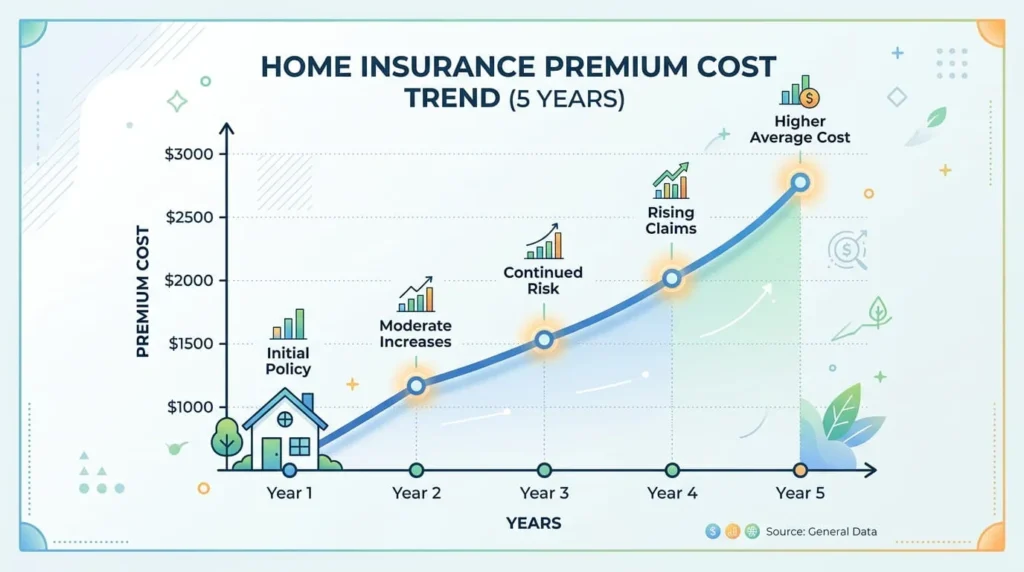
The effect is uneven. Homeowners in the highest-risk zip codes for climate-related losses now pay well above the average for their state, sometimes more than 80% above homeowners in the lowest-risk zip codes nearby. Some insurers have also pulled back from writing new policies in the most exposed areas entirely, choosing instead to shrink their book of business in states where storm losses have been heaviest. If your insurer nonrenews your policy, replacement coverage in a high-risk zip code can be both harder to find and more expensive than what you were paying before, so it is worth starting the search for a new policy the moment a nonrenewal notice arrives rather than waiting until the current one lapses.
How to Get an Estimate That Actually Reflects Your Home
A national average is a reference point, not a quote. To get a number you can actually budget around, request quotes from at least three insurers using the same coverage limits, deductible, and endorsements for each one, so you are comparing like for like.
Ask each insurer to base your dwelling coverage on rebuilding cost rather than market value. These two figures often diverge significantly, especially in expensive housing markets where land value makes up a large share of the sale price but adds nothing to what it would cost to rebuild the structure itself.
An independent agent who works with multiple carriers can also surface regional insurers that a quick online search will not show you. Smaller regional companies sometimes beat the large national brands by a wide margin in specific states, particularly ones where major insurers have scaled back. It is also worth asking each insurer directly what discounts you qualify for, since some savings, like a claims-free history with a previous carrier, are not applied automatically and have to be requested.
Practical Ways to Lower the Premium Without Losing Coverage
A handful of changes reliably move the number without leaving your home underinsured. Raising your deductible from $500 to $1,000 can cut your premium by roughly a quarter. Bundling home and auto policies with the same carrier often saves another 10% or more. Installing a monitored security system, updating an aging roof, and staying claim-free for several years all typically unlock additional discounts as well.

One caution worth stating plainly: do not lower your dwelling coverage limit below your home’s actual rebuilding cost just to shrink the premium. If a total loss happens, an underinsured policy leaves you paying the difference out of pocket, and that gap is often tens of thousands of dollars.
When the Average Does Not Apply to You
Certain homes fall outside the standard pricing model entirely. Custom or high-value homes often need specialized or excess coverage that a standard policy will not fully price into a typical average. Homes in a FEMA-designated flood zone need a separate flood policy, since standard homeowners coverage does not cover flood damage regardless of what caused it. Older homes with outdated electrical, plumbing, or roofing systems sometimes cannot get standard coverage at all and end up priced through a surplus lines market at a noticeably higher cost.
Homeowners who own their home outright are not legally required to carry insurance, and roughly one in five choose to go without it once the mortgage is paid off. That decision carries real financial risk, since a single uninsured loss can erase years of built-up home equity.