


What does income restricted mean when you see it on a rental listing? It means the apartment is reserved for households that earn less than a set amount. Your income must fall under that cap to qualify. In return, the rent is capped too, so it usually costs less than similar market-rate units nearby.
The label sounds simple, but the details trip people up. Limits change by city, household size, and program. This guide explains how the rules work, who qualifies, and what happens if your pay rises later.
What Does Income Restricted Mean In Plain Terms?
An income-restricted apartment has a maximum household income for move-in. Property owners agree to that limit in exchange for something of value. That might be tax credits, public funding, or permission to build a larger complex than zoning normally allows.
The restriction attaches to the unit, not to you. In most cases a private company still owns the building. A leasing office collects rent and handles repairs like any other apartment community.
Some communities are fully restricted. Others mix restricted units with market-rate units under one roof. The two often share the same floor plans and amenities.
How Income Limits Are Set
Limits come from Area Median Income, or AMI. HUD publishes AMI figures every year for each county and metro area. Programs then set the cap as a percentage of that number.
Limits also change with household size. A single renter has a lower cap than a family of four in the same unit type. Properties post a chart showing the cap for each household size.
Common Income Tiers
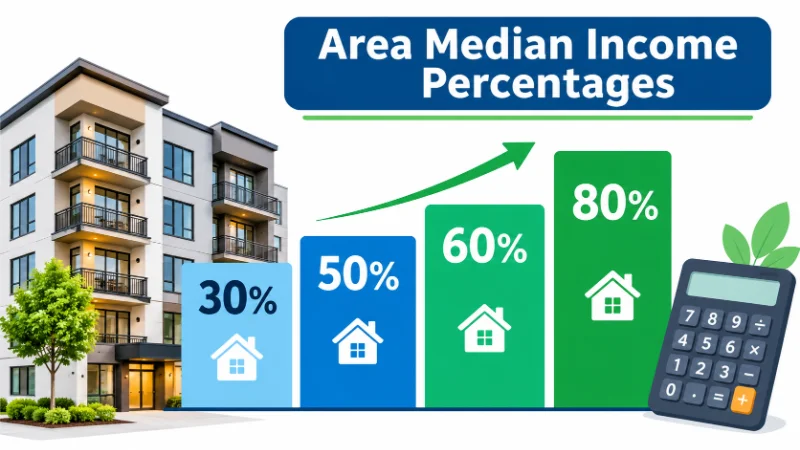
Most restricted units sit between 30% and 80% of AMI. The lower the percentage, the deeper the restriction.
Units at 30% AMI serve very low earners. Units at 50% and 60% AMI are the most common in tax-credit buildings. Units at 80% AMI reach moderate earners, such as some teachers and nurses in expensive cities.
Some newer buildings mix several tiers in one property. That lets an owner serve a wider range of incomes.
A Worked Example
Say the AMI in your county is $80,000. A unit set at 60% AMI would cap income at $48,000 for a four-person household. Smaller households get a lower figure.
The rent cap is usually 30% of the income limit that matches the unit size. If that limit is $48,000, the cap is $14,400 per year, or $1,200 per month. That figure typically includes a utility allowance.
These numbers are only an illustration. Your local chart will differ.
How Rent Works In Income-Restricted Apartments
Rent is a fixed amount tied to the unit, not to your paycheck. Two tenants in matching apartments pay the same rent, even if one earns more, as long as both stay under the cap.
The cap is a ceiling. Owners can charge less, and they cannot charge more than the posted maximum.
Watch the utility allowance. If you pay your own electricity or gas, the owner subtracts an estimated utility cost from the maximum. Your base rent drops, but your total housing cost stays near the cap.
Rent can still rise at renewal, because the cap moves when HUD updates limits each year. Increases are limited by that cap, not by what the neighborhood will bear.
Income Restricted Vs Income Based Vs Section 8
Once you know what income restricted means, the lookalike terms are the next hurdle. They work differently.
Income-restricted housing sets a ceiling on who can move in and a ceiling on rent. Income-based housing sets your rent as a share of your actual income, commonly around 30%. Section 8 is a federal subsidy that pays part of the rent to the landlord.
| Housing Type | How Rent Is Set | Who It Serves |
| Income Restricted | Fixed cap based on AMI | Households under the income limit |
| Income Based | About 30% of your adjusted income | Low-income households |
| Section 8 Voucher | You pay a share of income and the subsidy covers the rest | Approved voucher holders |
| Market Rate | Set by the owner and local demand | Anyone who passes screening |
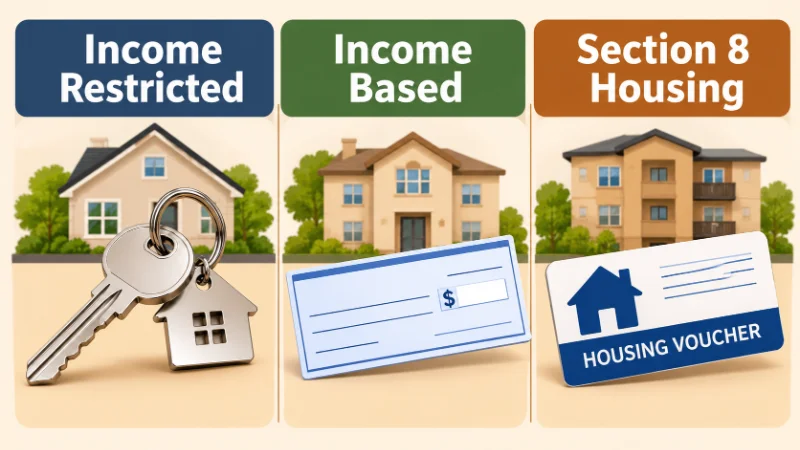
The practical difference shows up when your income changes. In income-based housing, rent moves with your earnings. In income-restricted housing, rent stays at the cap whether you earn far below the limit or just under it.
Affordable housing is the umbrella term. It can mean any of the first three structures, so ask which one a property uses.
Programs Behind Income-Restricted Apartments
1: Low-Income Housing Tax Credit Properties
The Low-Income Housing Tax Credit, or LIHTC, funds many privately owned restricted apartments. Developers receive tax credits and agree to cap rents and incomes for many years.
Traditional LIHTC units serve households earning no more than 50% or 60% of AMI. An income-averaging option now lets owners designate units from 20% to 80%, as long as the average stays at or below 60%.
2: HUD-Assisted And Local Programs
Some buildings take federal subsidies through HUD multifamily programs. Others use HOME funds or state housing finance money. Cities also create restricted units through inclusionary zoning, which asks developers of new buildings to set aside a share of units.
Each program has its own paperwork, so two buildings on the same street can ask for different documents.
3: Mixed-Income Buildings
In mixed-income buildings, only some units carry the restriction. Your neighbor might pay market rent. Ask whether restricted units go by lottery, waitlist, or first come, first served.
Who Qualifies For An Income-Restricted Apartment
Qualification starts with total household income. That means the gross income of every adult who will live in the unit, before taxes. Wages, self-employment earnings, Social Security, unemployment benefits, and other regular payments usually count.
Household size matters because it sets which limit applies. A bigger household gets a higher cap but needs a larger unit.
Passing the income test does not guarantee approval. Owners still check rental history and criminal background. Credit standards vary by property.
Minimum Income Requirements
Many people assume there is only a ceiling. Some properties also set a floor. An owner may require income of two or three times the monthly rent, even in a restricted building. Voucher holders are often treated differently, since the voucher covers part of the rent.
If you earn very little, ask directly. Policies differ and exceptions exist.
Student And Asset Rules
Tax-credit properties often limit households made up of full-time students, with exceptions such as married couples filing jointly and single parents. Some programs also count savings or property income when they calculate eligibility. Ask for the full rules before you apply.
Pros And Cons Of Income-Restricted Housing
The main benefit is a lower, predictable housing cost. Capped rent leaves more room for food, transport, and savings. Some buildings are newer and include features like in-unit laundry or fitness rooms.
The trade-offs are paperwork and limits. You document your income every year. Waitlists can run long. Location and unit choices are narrower than on the open market.
If you expect a raise soon, ask how the property handles over-income households before you sign.
How To Apply For An Income-Restricted Apartment
Applications take longer than standard rentals. Preparation shortens the process.
- Search for listings labeled affordable, tax credit, or income restricted. Property websites often post these terms directly.
- Find the current income chart for your household size and compare it to your gross annual income.
- Confirm the unit size you need and whether the waitlist is open.
- Gather recent pay stubs, tax returns, bank statements, benefit award letters, and photo ID for every adult.
- Submit the application and answer follow-up requests quickly. Missed deadlines can drop you down the list.
- Expect income verification. Staff may contact your employer directly.

Why Waitlists Are Common And How To Handle Them
Demand for restricted units often exceeds supply, so waitlists are normal. Some close for months. Others use a lottery.
Apply to several properties at once. Stay flexible on unit size when you can. Keep your phone number and email current, because owners drop applicants who do not reply.
Ask each property how long its list is and how often it updates. A quick call tells you whether a list is worth joining.
What Happens If Your Income Changes
Most owners recertify your income every year. Report household changes as your lease requires. Hiding income can put your lease at risk.
A raise does not mean immediate eviction. In tax-credit buildings, you can generally stay even if your income passes the limit.
A stricter threshold applies at 140% of the limit. If your income climbs past it, the owner must rent the next available comparable unit to a qualified household. This is called the next available unit rule. You often keep your home.
Some HUD and local programs handle over-income households differently, including higher rent or required move-out. Read your lease.
If your income falls, fixed-cap rent usually stays the same, while income-based rent can drop. Ask management about hardship options.
Myths About Income-Restricted Apartments
Restricted apartments are not automatically older or lower quality. Some are new construction, and condition varies by property like any other rental. Tour before you decide.
They are also not reserved for people without jobs. Many residents work full time. Cashiers, caregivers, drivers, and office staff often fall under the limits in high-cost areas.
Finally, restricted does not mean free. You still pay rent and sign a lease, and you may owe fees or a deposit.
How To Tell If A Listing Is Income Restricted
Listings use different words. Look for income restricted, affordable, tax credit, LIHTC, AMI, or set-aside. Some marketplaces add an income-restricted badge.
If a listing does not say, call the leasing office and ask for the current income chart. Confirm the restriction before you pay an application fee.
Be careful with anyone who promises guaranteed placement for a fee. Legitimate properties screen everyone the same way.